Popular Posts

Showing posts with label Cambridge Food and Wine Society. Show all posts

Tuesday, 26 March 2013

Tour de Belfort at Cambridge Food and Wine Society


Eugene Lismonde set up his Tour de Belfort winery and guest house near Cahors just a few years ago after retiring from his business in Paris.

It is a truly family affair with Eugene and wife Sylvie running the winery and daughter Muriel overseeing sales in the UK.

It has proven a tough market to break into - Eugene describes making his organic, low-intervention, almost natural wines in a brand-new vineyard and winery as being "the easy part"; he summarises the problem as not having the volume or pricing to be able to work with supermarkets, nor yet having the reputation of the classic areas to deal with independents.

After a couple of years of direct selling via the Three Wine Men events and through the company's website, Muriel has come up with a new idea that might just be the breakthrough they have been looking for.

Le Vin La Table in Hale, Cheshire is part wine shop and part cookery school - Muriel has recruited chef Jason Palin to provide cookery lessons with food matched exclusively to the Tour de Belfort wines.

With originally just a red blend and white blend, this could have proven somewhat limiting, so Eugene has expanded his range, to include a fizz and two oak-aged single-variety grands vins which he included in a presentation to Cambridge Food and Wine Society at the weekend.

The fizz - a methode traditionelle - is fresh, elegant and clean, with pure fruit expression and good persistence on the finish. At under £12, it is also something of a bargain.

The various white and red blends show the same pure fruit and technical excellence, with a well-balanced vibrancy and, for the reds, perfectly ripe tannins.

Preferences are perhaps more of a personal matter - for me the 2009 white blend (a cooler year containing a higher proportion of Sauvignon in the blend) has a lovely acidic streak, whilst others preferred the weightiness of the Chardonnay-dominated 2010 (from a warmer year).

However, there was a general consensus that the Malbec-dominated 2011 with its pure fruit and smokey spiciness was the most enjoyable of all the reds.

On this theme, Eugene noted that the wines that had won awards in France had failed to register with Decanter in the UK, whilst those that had received Decanter wards had not received the same recognition from the French judges.

Tour de Belfort wines are available via the company's website, at The Gonville Hotel in Cambridge and now at Le Vin La Table in Hale.

Other related articles
Tour de Belfort - the history, the red, the rose, the white

Links
Tour de Belfort - website
Muriel Lismonde - twitter
Le Vin La Table - website
Jason Palin - twitter
Cambridge Food and Wine Society - website, twitter
The Gonville Hotel - website

Sunday, 21 October 2012

Inder's Kitchen at Cambridge Food and Wine Society

Nick and Inder Bull formed Inder's Kitchen just under two years ago; London professionals with a young family, they moved out of the Big City to somewhere more genteel and, frustrated by the lack of a decent Indian take-away in Cambridge, decided to set up their own.

Now selected as one of just three finalists in this year's BBC Food and Farming awards, their order-takings have suddenly gone through the roof and they are looking at the next stage of development in what Nick described as having been a hard slog so far.

Fortunately for the Cambridge Food and Wine Society, Nick was able to take time out from running the Inder's twitter account and washing up pots and pans to present some of their foods along with wines matched by Jamie Harrison of Noel Young Wines with whom the have already run a number of joint events.

Indian food and wine are not natural bedfellows - whilst aromatic Thai and Vientnamese dishes often work well with well-structured Big Whites such as oaked Chardonnay or Riesling, the traditionally oily, sweet and hot dishes of an Indian take-away are often better suited to beers.

However, things are a little different at Inder's Kitchen and the food, whilst recognisably from a curry house, is made to a much higher standard and is more gastropub than Mill Road.

The challenge with matching these foods to wines, then, is that they need to be big enough to stand up to the food, with high acidity to cut through the richness of the sauces, good aromatics and (for the reds) low tannins in order not to clash with the bitterness of the spices; a touch of residual sugar also helps.

Furnished with a copy of the evening's menu, Jamie picked out a great set of wines that met all the criteria and matched perfectly with the dishes.

The Starters

Lentil cakes with shallots and fresh ginger, served with a tomato chutney - matched with St.Clair Riesling 2011, Marlborough, New Zealand £13.49

Chicken tikka bites served with a mint and coriander chutney - matched with Emiliana Adobe Gewurztraminer 2011, Rapel, Chile £8.19

The Mains

South Indian chicken curry with mustard seeds and curry leaves - matched with Running With Bulls Tempranillo 2011, Barossa, Australia £11.29

Mysoor tomato dal - matched with Planeta 'La Segreta Rosso' 2011, Sicily, Italy £8.75

Desserts

Coconut and raisin flapjack and gulab jamun - Paul Cluver Noble Late Harvest Riesling 2010, Elgin, South Africa £13.95

You can read Heidi Sladen's account of the evening on The Moving Foodie Blog.
Links

Cambridge Food and Wine Society - website, Facebook, twitter, LinkedIn
Inder's Kitchen - website, twitter, Facebook
Noel Young Wines - website, twitter, Facebook

Other related articles:

More on the Cambridge Food and Wine Society generally.
More on Noel Young Wines generally.

Tuesday, 11 September 2012

Argentinian Wines With Wink Lorch at Cambridge Food and Wine Society‏

O Fournier in Uco Valley‏, Mendoza: photo by Wink Lorch
It's been seven years since I last saw Wink Lorch presenting on Argentinian wines to the Cambridge Food and Wine Society, but at the weekend, I got a chance to catch up when she returned to present eight wines from the Salta and Mendoza regions.

Having travelled several times to Argentina, Wink knows the country well and really brought the wines to life with stories about the wine-makers behind them and the regions.


Some key facts about Argentina from Wink:

- the country is very dry and vines have to be irrigated, often using canals built by the native inhabitants which visiting Scottish engineers declared "impressive"
- whilst the country cannot claim (as neighbouring Chile can) to be completely phylloxera-free, most of the vines are ungrafted with correspondingly higher vine ages
- almost all wines are made at high altitude; ranging from 700m to 1,500m in Mendoza and between 1,600 and 3,000m+ for Salta
- Salta, in the far north of the country, is technically in the tropics - hence the need to plant vines at altitude for coolness and length of growing season
- the grape varieties (of which Torrontes and Malbec are the most famous) are a mix of descendants of those brought by the Spanish settlers (Torrontes), those brought over from Europe in the mid-C19th (Bordeaux varieties, Tempranillo and Bonarda) with Chardonnay as a more recent addition
- grape varieties are 30% white and 70% red
- Argentina has the largest plantings of Tempranillo outside Spain
- distances between the vineyards and the wineries can be huge with the grapes trucked in bulk; this is reducing, however, for quality-led export wines
- with a large Italian immigrant population, Argentina has something of an Italian feel that is reflected in its lifestyle, culture and the wines themselves

The Whites
 
 
We started with an example of Argentina's signature white grape, Torrontes (which I have historically struggled with).

Faldeos Nevados Torrontes 2011 Salta 13.5% (£7.50, The Wine Society)
A relative of Muscat d'Alexandria and Mission, it is a sandy yellow in the glass; ripe, floral aromas with peaches and apricots. Pleasant hint of yeasty apricot skins.

The palate is mouthfilling and waxy, with pineapple and exotic fruit - peachy texture reminiscent of Viognier, but balanced by good fresh acidity and not cloying. Good length.

I was pleasantly surprised at how much I enjoyed this wine and was reminded of a Gelber Muskateller from Austria's high-altitude Styria - both floral grapes that, for me, benefit greatly from high acidity being maintained to offset the perfumey aromas.

Very well received by the group.

Mendel Semillon 2010 Mendoza 13.5% (£9.75, The Wine Society)
A yellowy-green in the glass, with not so much on the nose - just some hints of diesel, ripe citrus and a touch of lime zest. On the palate, there is good lime fruit, a creamy leesiness and fresh acidity.

Less extrovert than the previous wine, this initially felt a little elusive and underwhelming after the all-singing, all-dancing Torrontes. However, after a little "palate acclimatisation", it revealed itself to be well-made and well-balanced; a soul-mate rather than a bouncy young thing.

Catena Chardonnay 2010 Mendoza 13.5% (£12:20 Waitrose)
A golden yellow, there are aromas of spicy oak and exotic fruit. Ripe, buttery and creamy on the palate, with more exotic fruit - a slight hint of hot alcohol on the palate.

Distinctly New World in style, not at all Burgundian, yet fresh and not blowsy. Wink observed that the nearest comparison would be a cool part of California, such as Carneros.

Overall, this was considered to be a solid, workmanlike example, but lacking a touch of individuality - especially at the price.

The Reds
 
 
Faldeos Nevados Bonarda 2011 Mendoza 13% (£8.25, The Wine Society)
Bonarda is Argentina's second-most planted red grape after Malbec. There is Bonarda in Italy, but it turns out to be a completely different grape and the true European equivalent is Savoie's Corbeau (aka Charboneau in California).

Lots of ripe, primary bramble fruit on the nose. Juicy acidity and low tannins on the palate with some black and red cherry fruit.

Distinctly Italian in style, it has a rasping acidity that demands to be matched with tomato-based dishes - not at all a quaffer, then.

Gestos Shiraz 2009 Mendoza 14% Bodegas Finca Flichman (£9.99 Majestic)
Lots of ripe bramble fruit, baked fruitcake and vanilla spice and sweetness. Ripe, rounded tannins.

For me, and others, this was rather overdone and a case of more is less.

Catena Zapata The Wine Society Cabernet Sauvignon 2009 Mendoza 13.5% (£10.75 The Wine Society)
A version of Catena CS (not really Catena Zapata which is a higher level of wine), this specific blend is unique to The Wine Society and features a higher proportion of wines from higher altitude and all aged French oak - overall, a good thing. For completists, there is also some Malbec and Cab Franc in the blend, adding spice and perfume.

A complex nose of liquorice and leather, blackcurrant and red peppercorns. On the palate, there is blackcurrant fruit, more acidity, chocolatey-ness and spice. It feels elegant and balanced, with good structure and lovely ripe tannins.

Drinking well now, it still has good ageing potential.

A really lovely wine - for me and many, the best of the reds, perhaps because it is the most European in style.

Amalaya 2010 Salta 14% Bodegas Colome (£10.79 Majestic and Noel Young Wines)
A Malbec blend, this also features some Cab (15%), Syrah (5%) and Tannat (5%); the nose shows spicy bramble fruit, something floral and some fruitcake.

On the palate, there is red and black cherry fruit, peppery grip and juicy acidity, plus some subtle oak and soft tannins.

Noel Young describes this wine as "a touch lighter than straight Malbec ... makes a nice change; really bright and vibrant."

O Fournier Alfa Crux 2004, Valle de Uco, Mendoza 15% (£22.99 Waitrose)
A blend of Tempranillo (50%), Malbec (30%) and Merlot (20%), this is a big beast of a wine - in the glass, it shows some brick-red hints of age around the rim. The nose is complex with meaty aromas, iodine / medicinal hints, cherry fruit, spice, leather and roasted coffee, whilst the palate is mouthfilling and fruitcake-rich.

From old vines all grown at over 1,000m and 17 months in new oak, it is an accomplished and impressive wine - with many awards.

And yet, and yet ... it feels just too much, too over-the-top. That full-on ripeness and everything-including-the-kitchen-sink may wow the critics at tastings and competitions, but for me, it's a Nancy Dell'Olio of a wine - smart and not unattractive, but I couldn't live with it.

Conclusions

In a word association game, you say Argentina and I think of Malbec and Torrontes.

Wink's presentation showed that Argentina is a more diverse wine-producing country than one might first think and gave some great insights into what the country is like.

With the 33 colleges that make up the university here, each with its own cellars and buyers, and a large number of independent wine merchants, the average palate in Cambridge is probably rather classical. As a result, whilst all the wines were recognised as being well-made, those that were most appreciated by Society members were generally the more European-style, lower-alcohol ones.

Recommended Wines
 
My own favourites were:

- the Torrontes for its peachy texture, long palate and fresh acidity
- the Catena Zapata Cab for its elegance, complexity and overall assuredness

Both from The Wine Society.

Links

Wink Lorch - website, Facebook, Twitter, LinkedIn
Wines of Argentina - http://www.winesofargentina.org/
Cambridge Food and Wine Society - website, Facebook, Twitter, LinkedIn

The Wine Society - http://www.thewinesociety.com/
Noel Young - http://www.nywines.co.uk/
Majestic - http://www.majestic.co.uk/
Waitrose - http://www.waitrosedirect.com/wine

Image Credit - Main picture: O Fournier in Uco Valley‏ reproduced by kind permission of Wink Lorch


Friday, 22 June 2012

Joseph Barnes Wines at Cambridge Food and Wine Society

The Languedoc, according Charles Hardcastle of Joseph Barnes Wines, is a rustic, peasanty land with an ancient and bloody history - a land of impenetrable dialects, heresy and repression.

The strange, earthy character of the region is also reflected in the wines, which tend towards an expressively rustic, spicy charm.

Add to this Charles' natural showmanship and charisma, a touch of biodynamic mysticism, some meteors and space dust and it was a highly entertaining evening at the Cambridge Food and Wine Society.

The Languedoc was historically the source of Europe's wine lake - gallons of cheap, unpleasant plonk dumped on the market. But quality has been improving for as long as I can remember and it is now a source characterful, well-made rough-and-tumble wines that can be rather serious indeed.

Chateau Le Roc Fronton, NV £30 magnum

This natural wine is in simple terms a pink fizz; more precisely, it is a petillant blend of Negrette and Mauzac made by a single fermentation in bottle according the euphemistically-named Methode Rurale, with no added sulphur and fined only by racking.

A cloudy pink in the glass, there are pear drops and red berries on the nose. The palate shows good acidity and primary fruit aromas of apple and galia melon. Good depth of flavour, but not especially complex and just 9% alcohol.

A very popular seller at Charles' shop, it was well-received on the evening.

Domaine des Foulards Rouges, La Soif du Mal Blanc 2011, £14

This white blend is a mix of Grenache Blanc, Muscat and Macabeu; a pale yellow in the glass, there are Muscaty aromas of honeysuckled and blossom on the nose.

The palate shows a good leesy depth, with sweet acacia blossom, rounded, lemon-and-lime acidity, more Muscaty florality and a mineral edge.

Suggested food matches were sea bass with fennel or chili and ginger.

Domaine de l'Hortus, Bergerie de l'Hortus Blanc 2011, £12.95

This white is a blend of Chardonnay, Grenache Blanc, Sauvignon Blanc, Viognier and Roussane.

The nose shows pear and orchard fruit, spice, stone fruit, lemon and pineapple and a leesiness. Long on the palate, there is more orchard and tropical fruits, a soft peachy texture, good leesy depth and a persistent finish.

Chateaux Ollieux Romanis, Corbieres Rose 2011, £9.25

Mainly Carignan, but with some Syrah and Grenache, and a pale salmon pink colour, this is made by carbonic maceration which gives something of a bubblegum aroma.

With a savoury, spicy nose, there is watermelon on the palate, prominent rounded acidity, a touch of mint and pepper, minerality and a toasty-yeastiness with a good, leesy finish.

Domaine du Meteore, Faugeres, Les Leonides, 2008, £9.20

A GSM + Carignan blend, this has a rustic charm, with an earthy, funky nose of barnyardy wet hay, plus some spice, coffee and a mix of red, black and sour cherries.

On the palate, there is sour cherry fruit, garrigue herbs and tarriness.

The finish is savoury and this would match well with robust meat dishes.

The name of the domaine is a reference to a crater in the vineyard caused by a meteorite, so there may just be traces of cosmic space dust in the wine.

Ch Ollieux Romanis, Alicante-Bouschet, VdP Aude, 2011, £15.99

This is made from 100 year-old vines from the obscure Alicante-Bouschet grape - the last 2 hectares in France, apparently.

In the glass, it is dark and impenetrably inky - which apparently made it popular in prohibition-era America as it could be significantly watered down and still retain some colour.

With dark berry fruit and mocha on the nose, the palate shows elderberry fruit, peppy spice and mintiness.

It is concentrated and long, with a custardy texture and a lively, juicy acidity.

The finish is grippy, savoury and meaty and it would match well with spicy meat dishes such as tagine.

Chateau de Jau, Banyuls Rimage, Les Clos de Paulilles, 2008, £11.99 (50cl)

The final wine of the night was a Banyuls - Languedoc's answer to tawny port.

Made from 100% Grenache, but naturally sweet due to fortification up to 16.5% alcohol with grape spirit, it had aromas of raisins and garrigue herbs and a sweetness cut through with good acidity.

Utterly delicious on its own, it was a perfect match with good quality dark, bitter chocolate, and proved very popular on the evening.

Recommended Wine

If you are looking for a reason to visit an independent wine merchant, Joseph Barnes Wines is it; characterful, rounded and quirky - and that's just Charles Hardcastle.

What struck me was the quality of all the wines - mostly organic, often biodynamic and / or natural, they feel incredibly well-made, both technically and stylistically.

They are also unashamedly crowd-pleasing with lots of personality.

Given all this, it's hard to pick a best overall wine of the evening but the Domaine du Meteore was especially notable for being both excellent and under a tenner.

Links

Cambridge Food and Wine Society - http://www.cambridgefoodandwinesociety.org.uk/
Joseph Barnes Wines - http://josephbarnes.webdev.perceptive-office.com/home.aspx

Saturday, 28 April 2012

Limoncello at Cambridge Food and Wine Society (with La Dante)

After I arranged a tasting of Italian wines for La Dante in Cambridge last year, Giulia Portuese-Williams, who runs the centre, suggested we do a joint event together with the Cambridge Food and Wine Society.

When, shortly afterwards, I made contact with Steve Turvill who runs Limoncello on Mill Road, everything fell into place and we agreed to promote the event together using our various Twitter accounts and Facebook groups.

La Dante in Cambridge is part of the international la Società Dante Alighieri, founded in 1889 with 440 offices worldwide - it is a national cultural institute rather like the British Council or the Goethe Institute, but unlike these it is not state-funded and so needs to rely on language lessons for its income.

As the old adage goes, I'm sure at least half of our social media efforts were wasted, but I've no idea which half; in any case it proved to be the best attended event the Society has held for a long time.

Numbers aside, it also proved very popular with both Society and La Dante members as well as the new guests who came along, including Caroline Biggs who writes an excellent  blog on Cambridge's hidden past, The Real Cambridge.

After introductions and welcomes, Giulia briefly spoke about La Dante which has recently moved into new offices, describing her experience of British bureaucracy as what she hoped to leave behind when she left her native Italy.

She also made an open invitation for everyone to drop into La Dante to see the new offices and have a cup of real Italian coffee, but I suspect that may not apply to the powers that be that oversee property moves in Cambridge.

We started the event itself with a Prosecco, Villa Sandi Millesimato 2011 Valdobbiandene - with ripe pear fruit, hints of yeasty brioche and good depth on the palate, it had good, food-friendly acidity and a long finish.

The name was familiar and reviewing this blog, I see that I tried a sparkler from Sandi some time ago and checking my notes, was impressed with it then as well.

Steve then invited us to try two different sets of olives - the first cured, the second marinaded; the accompaniment to this was a Sicilian Grecanico, Vinali Roccamora Sicilia. Also known as Garganega in Soave and with just 12% alcohol, it was crisp and fresh. A sandy yellow in the glass, it had an expressive nose, with herbaceous, floral hints, white pepper spice and toasty yeastiness; there is lemony citrus on the palate, and a long, savoury finish

There followed a series of "taste tests", starting with two olive oils; both had been poured into unmarked containers and we were invited to decide which we preferred - one being significantly more expensive than the other.

For me, olive oil should be strong, fruity and peppery and I was sorry to learn that my preferred, more-strongly flavoured oil proved to be the more expensive one.

This set up something of a pattern as we then repeated this with two types of cured ham - both were very good, but I found myself slightly preferring the (more expensive) San Daniele compared to the Prosciutto.

Next were two lots of balsamic vinegar to try - the first was thick, gloopy and sweet, whilst the second was incredibly complex and quite wonderful, so there were no surprises when #1 proved to be a basic "balsamic glaze" whilst the second was a 25yo, extremely expensive balsamico tradizionale.

We accompanied this part of the tasting with a Sangiovese; with cherry fruit and vanilla spice on the nose, there was juicy sour cherry on the palate which opens up and becomes more rounded with air.

Steve's chef Paul then made some pesto freshly using a blender which we compared to some from the shop; I found myself preferring the shop-made pesto for its stronger flavour and higher cheese content, but a number of people on the table who are regular visitors to Italy found the more herbaceous, freshly-made pesto to be typical of what they had experienced in Italy.

This led on to a discussion with Giulia about how best to keep basil in Cambridge - whilst I can grow rosemary, tarragon, parsley and chives in our south-facing garden, I've never been successful with basil.

According to Giulia, basil needs hot, damp conditions to thrive - essentially a Mediterranean climate, which is not easily reproduced in Cambridge - so I am unlikely to be making pesto from home-grown basil any time soon.

We then moved on to a comparison of three types of cheese - a Pecorino Fresco which had a soft texture, a firmer and stronger aged Pecorino with saffron and black pepper and some shaved parmesan, accompanied by bresaola, marinaded artichokes and various breads.

With this, Steve served an Elvio Cogno Vigna Elena 2005 Barolo; still relatively youthful at 6 years old, it was a pale, brick red in the glass with red and black cherry, tobacco leaf and pepperiness on the nose with cherry fruit, minty eucalyptus on the palate and a grippy finish.

The dessert section of the tasting featured home-made pannetone - better than any shop-bought one I have ever had - and cantuccini biscuits with a Moscato Sicilia; a golden colour, it had a an oxidative nose with a marmaladey palate cut through with fresh acidity.

The final digestivo was, appropriately enough a limoncello - a sweet lemon liqueur; on many occasions when eating out in Italy, I have found a sorbetto al limone con Prosecco a perfect digestivo at the end of a long, multi-course meal and the limoncello served the same purpose here.

With a zesty, pithy nose, it is initially intensely sweet and warming on the palate with a mouthfilling zesty, pithy bitterness that develops over time and a long, citrusy, aromatic finish.

It was a great event and very well received by Society members, those from La Dante and the large number of guests who came along - I put the success down to the sheer quality of the food and wine that Steve brought along for us to try, as well as to the way he ran the event; he is an easy-going, natural presenter and his love of and enthusiasm for all things Italian is very apparent - even if, as he admits, he would not actually want to live there.

For the final part of his talk, Steve explained how he had first got involved with Limoncello; in its previous guise, it had been his favourite deli and when it went bust, he bought the business and ran it as a sideline to his day-job. After a few years, the business was successful enough for him to do it full time and he is now looking to expand with further branches in the Cambridge area.

It should come as no surprise that there were a number of expressions of interest from the audience at this point.

Links

Cambridge Food and Wine Society - website, Facebook, Twitter
La Dante - website, Facebook, Twitter
Limoncello - website, Facebook, Twitter

Review of Limoncello on Wanton Flavours - http://wantonflavours.blogspot.co.uk/2011/01/limoncello.html

More on Elvio Cogno from Chris Kissak - http://www.thewinedoctor.com/italy/cogno.shtml

Tuesday, 20 March 2012

Hedonist Wines‏ at Cambridge Food and Wine Society

I first came across Hedonist Wines when owner Anthony Jenkins got in touch after reading an article of mine in the local press in Cambridge.

We exchanged emails and I agreed to review a couple of his wines and was reasonably impressed, so I later arranged for him to give a presentation to the Cambridge Food and Wine Society.

The tasting took place this weekend and in the interim, Anthony has gone from being something of a hobbyist with a "real day-job" to having wine-retailing as his main activity, so clearly something has worked well.

Whilst Hedonist remains a small operation, perhaps what is most interesting about it commercially is that the business model involves buying directly from producers, by-passing the traditional importer-distributor networks; of itself, that is not especially innovative, but it does seem to be part of a growing trend of new, small-ish wine concerns working directly with producers from Europe.

Clearly, the rise of budget airlines, improved, lower-cost communications technology and a more developed logistics industry have a role to play in this, but Hedonist's price range, mostly priced at a little over £10, says something about wine-drinking habits in the UK.

The wines themselves are sourced from individual producers, mainly in the better-value parts of classic European regions, and the limited list is essentially a reflection of Anthony's palate and preferences; he describes his typical wine as the sort of wine you enjoyed on holiday from a small, local producer.

All the wines are exclusive to Hedonist and we started with a Crémant de Bourgogne from Domaine Joussier; made from 100% Chardonnay from the Côte Chalonnaise - geographically in the middle of Burgundy - it had a crisp nose with yeasty brioche aromas.

The palate shows ripe apple and pear fruit with a fine mousse - it feels elegant and well-made if light and not overly complex. It would make a good aperitif or celebration wine and at £11 is reasonable value for a classic French wine with bubbles in.

Next was a 2009 Côte Chalonnaise "En Reviller" from the same producer which had spent three months in oak - with ripe orchard fruits on the nose, it felt rounded and creamy on the palate with fresh apple and pear fruit and a minerally finish with just a touch of oaky buzz.

This was followed by something more unusual - a white Rioja Caecus Verderón 2010 made from 100% Viura with 3 months in oak. Pale straw coloured in the glass, it had a similar profile to the previous wine with ripe pear fruit and a toasty creaminess on the palate, but felt bigger and fuller.

The first red was a Burgundy, a 2008 Mercurey from Joussier - I was a little bit blind-sided by this wine; it is quite dark in the glass for a Pinot and shows aromas of ripe berry fruit, but with none of the typical Burgundian mushroomy, truffley undergrowth I had hoped for.

With good, primary fruit and a depth of flavour it was perhaps more typical of a good Beaujolais than a Pinot - very balanced and enjoyable as a wine, but just not at all what I had expected.

The 2008 Rioja Crianza from Caecus was surprisingly oaky but had a soft, smooth texture with cherry fruit, spice and liquorice on the nose and a grippy finish.

The 2006 Reserva, also from Caecus, had a degree more alcohol and more intense aromas on the nose as a result, as well as more complexity - dark purple in the glass, it shows berry fruit, liquorice and spice and feels riper and more perfumed. On the finish, it feels to have a better balance of fruit and grip.

The two final reds were both from Panizzi, based in Tuscany - the first, a 100% Sangiovese Chianti Riserva 2008, was purple in the glass with a hint of aged brick red; the nose is ripe with dark berry fruit, whilst the palate shows plummy fruit with a distinct smokiness.

An easy-drinker, it feels soft, rounded and mellow.

The Folgore 2003 "Super Tuscan" was a noticeable step-up; with small amounts of Cab and Merlot in the blend, it is labelled as a humble rosso, but was the most complex wine of the night, albeit the priciest at £16.

Intended to be aged for up to 20 years, the 2003 has only just been released. Inkily dark in the glass with an aged brick red rim, the nose shows forest fruit aromas. On the palate it feels mellow, muscular and complex, with good juicy acidity and grip.

Recommended Wines

For me, all the wines were well-made and, as a minimum, pleasant and drinkable even if few were really impressive.

There was no clear consensus either on our table or at the event generally on which ones were most popular - which is perhaps a good sign - but there were plenty of orders made at the end of the event.

And whilst I would happily drink any or all of these wines again, for me, the best was the Panizzi Folgore 2003.

Links

Cambridge Food and Wine Society - http://www.cambridgefoodandwinesociety.org.uk/
Hedonist Wines - http://www.hedonistwines.com/

Thursday, 15 September 2011

Naked Wines at Cambridge Food and Wine Society

I have been a customer of Naked Wines for around a year now and as a committee member of Cambridge Food and Wine Society, it made sense at some point to bring the two together.

So I invited Rowan Gormley, a charismatic South African entrepreneur who has worked as the right-hand man of charismatic British entrepreneur, Richard Branson and founded Naked Wines in 2008, to come and present some of his wines to a mixture of Cambridge Food and Wine Society regulars plus a group of Naked's own customers.

It proved to be a fascinating evening - for a number of reasons, mostly unrelated to the wines themselves as most fitted into, for me, a fairly standard pattern.

I find that Naked's wines have a very strong sense of identity or "house style" - well-made quaffers with generous up-front fruit, but not overblown in style, they are perhaps best categorised as "restrained New World style", coming generally either from the New World itself or Europe's New-World-style regions such as southern France or inland Spain.

We started with a Sachetto Prosecco NV; with simple, straightforward pear fruit, a ripe palate and a touch of yeastiness developing on the nose, it was a good example of what an enjoyable Prosecco should be.

With an eye to the mood of the audience, Rowan asked how many people preferred Prosecco to Champagne before going on to explain how many Champagnes can be just too acidic to be enjoyable as compared, say, to more drinkable Proseccos.

This was just the first of a series of communications master strokes from Rowan who clearly understand his audience, for whilst good Prosecco can indeed be more enjoyable (and cheaper) than poor Champagne, no Prosecco that I have ever tried has matched really good Champagne for complexity, intensity or sophistication.

With 15 wines to get through, we sampled them in pairs, generally from the same producer and usually a red and a white together.

Historically, I have generally found myself preferring Naked's white wines for quality of their structural acidity rather over the reds which, for me, are a little lacking in tannic structure and texture.

However, at this event, trying reds and whites side-by-side, I generally found myself preferring the reds.

Our first pairing of wines was from South African producer Carmen Stevens - the Chenin Blanc was herbaceous and fresh with lively acidity and a gentle minerality and showed a degree of restraint and sophistication from being grown on cooler, elevated, south-facing slopes.

The Shiraz showed typical pruney fruit with pepperiness, an inky texture and some grip on the finish.

The next two wines were from souther France's Benjamin Darnault - a Picpoul and a Faugères.

I have had the Picpoul previously and whilst it is a good example of the variety, at £9.99 I find it a little overpriced for such a straightforward wine which often retails for just a few Euros on its homeland.

The Faugères I found much more impressive - mainly Syrah, it had a toasty, tarry nose with eucalyptus notes whilst the palate shows bramble fruit, prunes, liquorice with a soft texture.

The next pairing, from Spain's Carlos Rodriguez, was an Albarinho that was crisp, fresh and floral with peach and apricot fruit followed by an unoaked Rioja which showed lots of up-front varietal fruit rather than the vanilla and secondary aromas one associates with Rioja.

In another commuications coup, Rowan outlined the oaking and aging regimes of Rioja, noting that a top-level Gran Reserva will have much less up-front primary fruit than an unoaked or more lightly oaked version and that people might well find themselves therefore preferring something with less oak.

The next wine was a Loire Sauvignon from Villebois whose wines I reviewed a while ago here and here - in style it is half-way between a traditional lean Loire and a full-on tropical kiwi, so it came as no surprise to learn that it was made by a French winemaker who has spent time working in New Zealand.

Next up were a pair of Argentinians from Mauricio Lorca which were both well-made, but not to my taste - a floral Torrontes with ripe fruit sweetness and a light, juicy Malbec with sweet prune fruit.

The logic of the next pairing, a Macon Uchizy from Burgundy and a red Alentajeno from Portugal, was not immediately obvious until Rowan pointed out the theme here was the use of oak.

The Macon Uchizy I thought was very impressive - the nose is toasty, whilst the palate is buttery-oatmealy with a creamy, smooth and rounded texture, balanced with fresh acidity and a toasty finish.

This was, for me, the most interesting white wine of the night - perhaps because it is the most different from Naked's usual style.

I was less impressed by the Portuguese wine which showed bramble fruit, black cherry and oaky tannins, but this is a country whose wines I feel I still haven't quite "got" yet.

We followed this oaky pairing with something designed to refresh palates - a Castillo de Tafalla Angels Selection Rosé which I reviewed here and was very impressed with once again.

Our final pairing was a couple of hot-climate big reds - a Cabernet Franc from Chile's Kimbao which I had expected not to like (albeit from fairly limited experience of Cab Franc) but which I enjoyed, perhaps because it was a far-from-typical example, and a sweetish Ishtar Shiraz with a Pinot-esque nose of decaying compost that I was less impressed with.

At the tasting, I sat next to fellow blogger Davy Kurniawan who blogs as Vinoremus and is an IWC judge, comparing notes as we went along rather like two avid trainspotters.

I also managed to get a very insightful appraisal of the Cambridge Food and Wine Society's website from someone who does this sort of thing for a living and whose website is here.

I note that for a nominal fee, she will advise whether one's blog stands any chance of being turned into a book - a process one client describes as being like root canal surgery, painful but necessary; which reminds me of the old adage that during a goldrush, the best money is in selling spades.

Recommended wines

White - Le Moulin de l’Oeuvre Macon Uchizy 2010, £11.49
Rosé - Castillo de Tafalla Angels Selection Rose 2010 , £7.99
Red - Benjamin Darnault Faugeres 2008, £9.99


Angels get 33% cashback on all purchases - details of the Angels scheme is here:

Links

Cambridge Food and Wine Society - http://cambridgefoodandwinesociety.org.uk/

Naked Wines - http://www.nakedwines.com/

The Wines - details

Sacchetto Prosecco NV
Carmen Stevens' Angels Reserve Chenin Blanc 2011
Carmen Stevens' Angels Reserve Shiraz 2010
Benjamin Darnault Picpoul de Pinet 2010
Benjamin Darnault Faugeres 2008
Carlos Rodriguez Artemisa Albarino 2010
Black Label Bargondia 2010
Villebois Prestige Sauvignon Blanc 2010
Mauricio Lorca Angels Reserve Torrontes 2011
Mauricio Lorca Angel's Reserve Malbec 2010
Macon Uchizy 2010
Montaria Tinto 2010
Castillo de Tafalla Angels Selection Rose 2010
Kimbao Syrah Cabernet Franc 2009
Balthazar Barossa Ishtar Shiraz 2009

Sunday, 11 September 2011

Bordeaux Tasting at Cambridge Food and Wine Society


Bordeaux is perhaps the most famous wine region in the world - and with good reason; its First Growth chateaux produce some of the most expensive wines in the world (with prices for the 2010 vintage rising dramatically due, in part, to the effect of China) as well as perhaps the most famous sweet wine, Yquem, with top Bordeaux now almost more of an investment medium than a mere fermented beverage.

Moreover, with a viticultural history dating back almost 2,000 years, Bordeaux is the spiritual home of such noble grapes as Merlot, Cabernets Sauvignon and Franc, Sauvignon Blanc and Sémillon.

Red Bordeaux, made generally from a blend of Cabernet Sauvignon and Merlot (sometimes with smaller amounts of other varieties) is typically tough and chewy in its youth, but matures into a wine that gives a blast of blackcurrant fruit with aromas of pencil shavings, tobacco and resin - with generally high tannins and acidity, it is very much a food wine and traditionally matches with plain roast dark meat, such as beef.

All of this makes the Asian-billionaire fascination with young Bordeaux all the more surprising, as drinking it young with the strong, hot flavours of oriental food is as sure a way as any to overpower the wine and make it seem thin, bitter and dull.

The answer lies in both the rarity value and relative ephemerality of Bordeaux (say compared diamonds, gold or yachts) as well as the Asian tradition of gift-giving and obsession with overt demonstrations of status) - a gross oversimplification, of course, but not a bad one as these things go.

Away from the over-priced, over-hyped, under-aged Bordeaux, the region is home to a further 8,500-plus chateaux producing over 700m bottles of wine every year - around the same volume as the whole of Australia.

And as Anthony Stockbridge, a CIVB-accredited wine educator and therefore something of a Bordeaux specialist, pointed out, not all good Bordeaux has to cost a small fortune.


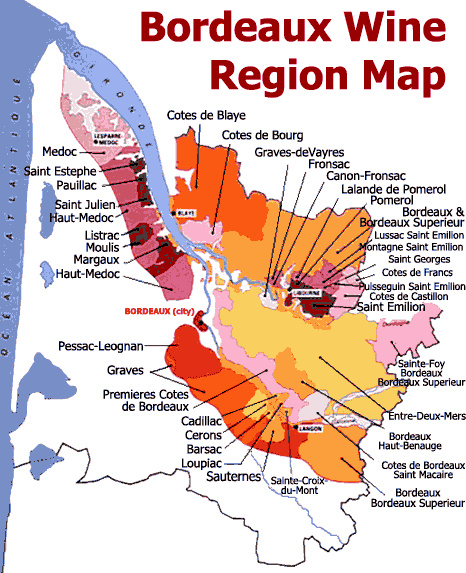
There are over 60 appellations in Bordeaux (see map), but the main distinction - for the reds that make up almost 90% of production - is between the right bank where Merlot dominates and the left bank where mainly Cabernet Sauvignon is grown.

However, Anthony started his presentation with two white blends. In Bordeaux, the whites pretty much have the status of also-rans amongst the very top wines but in the real world of wines under a tenner, they are increasingly gaining in quality and reputation.

The first from Château Bel Air, Perponcher Réserve was a 2009 Entre Deux Mers, made from 60% Sauvignon Blanc, 20% Sémillon and 20% Muscadelle (The Wine Society, £7.95). This had an unusual amount of Muscadelle in the blend but was fresh and dry and went well with Brie.

The second white, a Château Dubois Challon Fleur Amandine 2009 Bordeaux was 45% Sémillon, 50% Sauvignon and 5% Muscadelle (The Wine Society, £9.50); this was a more typical blend, barrel fermented and with the skins left in contact with the wine.

The wine spends around three months in oak casks, giving it a distinctive, oaked feel, although very different and more subtle than an oaked Chardonnay, for example. The palate showed ripe tropical fruit with a sweet almond finish and it proved the favourite of the two whites.

Moving on to the reds, we started with a Château La Grave de Bertin, 2009 - a Bordeaux Supérieur (meaning the alcohol content is slightly higher from riper - and theoretically better grapes) 70% Merlot, 20% Cabernet Sauvignon and 10% Cabernet Franc (The Wine Society, £7.25)

It was a very young wine but the high proportion of means it is low in tannins, making it a good everyday Bordeaux. The palate shows cherries, red fruit and plums and it was matched with cheddar to break through the ‘youthful’ taste.

The next wine was Château du Tailhas, 2005 Pomerol with 80% Merlot, 10% Cabernet Sauvignon and 10% Cabernet Franc (from the producer, £18.99)

2005 was one of the great years for Bordeaux and this wine needs a bit more time to mature fully, but is start to drink well now, with a soft and smooth nose, a good level of acidity and lots of fruit, it feels elegant, soft and velvety, with lowish tannins that make it a better match for lamb than the more traditional beef.

It will improve for a few more years and keep for another 10.

The next wine was a Château Tour St. Bonnet, 2003 from Haut-Médoc; a Cru Bourgeois, it was 45% Cabernet Sauvignon, 45% Merlot and 10% Cabernet Franc (Lay & Wheeler, £19.30).

The nose on this wine was quite different nose to the previous one, with cassis and leather from the Cab. Anthony described this as a good, middle-of-the-road wine with good structure and tannins and it was very popular on the night.

Moving further back in time, the next wine was a Château La Gurgue 2001 from Margaux, a Cru Bourgeois with an undisclosed blend, but dominated by Cabernet Sauvignon (Lay & Wheeler, £19.00)

This was really lovely wine with finesse and secondary aromas of liquorice, pencil lead and spices from aging and a complex, velvety palate.

The final red was a Château Batailley, 2003 Classé Pauillac with 65 % Cabernet Sauvignon, 25% Merlot and 10%Cabernet Franc (Lay & Wheeler, £24.00).

This was another absolutely wonderful wine with floral notes of violets on the nose and pine needles, cedar, spice on the palate; it is still relatively youthful and another two or three years' aging will soften the tannins.

The final wine of the evening was a sweet Château Cantegril Sauternes, made from 91% Sémillon and 9% Sauvignon Blanc (The Wine Society, £20.00).

With a complex nose and palate of honey, barley sugar, spicy apple, candied fruit, orange peel it was delicious and matched superbly with Roquefort.

With prices for 2010 Bordeaux first growths reaching astronomical levels, and moreover the wines not ready for drinking for a good 10 or so years, the event was a timely reminder that there is much better value to be had in wines of slightly lesser reputation from older vintages which are closer to being ready to drink now.

Links

Cambridge Food and Wine Society - http://www.cambridgefoodandwinesociety.org.uk/

Anthony Stockbridge & Associates - www.asa-training.co.uk

CIVB - http://www.bordeaux.com/Civb.aspx?culture=en-US&country=GB

The Wine Society - http://www.thewinesociety.com/

Lay & Wheeler - http://www.laywheeler.com/

Image credits:

Main image, Château Lafite-Rothschild (listed first in the 1855 Classification - although whether this was actually ordered by rank remains controversial, it continues to achieve the highest prices of the Médoc first growths): http://www.interestinwine.co.uk/images/categories/Lafite_Rothschild/lafite_10.jpg

Bordeaux appellations - map: http://www.terroir-france.com/picts/bordeaux_map.gif

Wednesday, 13 April 2011

Persian Food at Cambridge Food and Wine Society

In a first for the Cambridge Food and Wine Society, Saba Alai - originally from Teheran, the capital of Iran (formerly Persia) but living in Cambridge for almost two decades now - recently gave a tasting of traditional food from her homeland.

Saba's day-job is with a local company, but as an enthusiastic and skilled cook, she kindly agreed to prepare some traditional Persian dishes and talk about their history and provenance.

Although Persian food does not naturally have courses - people traditionally sit cross-legged on the floor and eat from a tablecloth, picnic-buffet style - we began with a simple starter-style dish, composed of herbs (coriander leaves, tarragon, flat-leaf parsley and chives) with feta cheese all wrapped up in a thin, but leavened, flat-bread.

This very ancient dish actually felt rather 21st century, much like a simple deli-style wrap, and I found the saltiness of the cheese brought out the flavours of the fresh herbs and bread without the need for any additional dressings.

Despite giving the world wine in around 3,000 BC, and wine historically having cultural and symbolic traditions in Persia, these days alcohol does not feature in Persian cuisine and so we had another traditional drink to wash everything down - pomegranate juice.

The one served on the evening, from Mahan (sourced from Al Amin deli on Mill Road), worked really well with the food as it had a rich, refreshing acidity which reminded me of the food-friendly sourness of Italian wines and prompted me to ask my neighbour, a bio-chemist at the University for a quick lesson on the different acids in wine.

As mains were laid out, Saba explained a bit more about Persian food - given its ancient origins, perhaps it is not surprising that many Persian foods have a particular association with religious festivals and events. The religion of ancient Persia was Zoroastrianism until the Arab conquest of 651 AD which (unlike Islam) does not forbid any foods but does dictate that the flavours used in different dishes should contrast with each other, with sweetness and sourness being a favourite.

As befits a country on a large land mass, Persia has influenced and been influenced by neighbouring countries - naan bread, a staple of many a so-called Indian restaurant, is actually Persian in origin and being soft, white and fluffy was the food of the courtiers where the darker, heavier, unleavened chapatti was more of a peasant staple, whilst the slow-cooked, spiced stews were similar to Moroccan tagines.

If specifically Persian restaurants are somewhat unusual outside of Iran, that is largely because Iranians do not go to restaurants much except for rice and kebab, which is their equivalent of fish-and-chips - a standardised, low-rent meal which is best cooked in a restaurant.

However, although most Persian cooking is done at home, typically Persian women only learn to cook in their first year or so after marriage when they regularly phone home to ask for instructions on how to prepare dishes for their new husbands.

Typical Persian main dishes are combination of rice with meat, lamb, chicken, or fish and some onion, vegetables, nuts, and herbs, as well as fresh green herbs along with fruits such as plums, pomegranates, quince, prunes, apricots, and raisins.

On this occasion our mains included two types of rice, a chicken stew with apricots, a deliciously tender lamb stew using some local free-range lamb and two yoghurt dishes that legend says were devised around 630 AD for Queen Purandokht who subsequently gave her name to them.

Whilst some of the dishes were spiced with cinnamon or saffron, unlike foods from neighbouring Pakistan or India, none was hot with chilis which do not feature in Persian cuisine.

Also, there is no tradition in Persia of preserving meat by salting it; rather, meat is simply cooked immediately after preparing, or (to put it another way) kept alive until needed.

For dessert, we had Ice in Heaven - a blancmange flavoured with rose water. The origin of the name is that, if ice existed in heaven, this is what it would taste like, and it was served with tea flavoured with cardamom, baklavas and delight (specifically not Turkish delight).

Saba explained that many middle eastern foods that are now familiar in Europe came via Turkey and so got labelled as Turkish in the process even if their origin was somewhere quite different.

Interestingly, many of the dishes and customs were familiar to me from my years spent living in Russia and Ukraine which may seem a long way from central Asia but were influenced by Iran as a trading partner on the other side of the Caspian Sea - indeed, Saba's grandfather was born in Moscow to Iranian traders based in Russia and spoke Russian as his first language.

The Food

Sabzi khordan - Fresh herbs with feta and flat bread
Chelo ba khoresheh morgh ba aloo - Persian rice with saffron, served with a “stew” of chicken, prunes and carrots
Sabzi polo ba gooshteh barreh - Herb rice, served with roast lamb
Kookooye Sib-zamini – A Persian omelette with potatoes
Borani-ye Laboo - Yogurt with beetroot
Borani-ye Esfanaj - Yogurt with spinach
Saladeh Shirazi - Salad of cucumber, tomatoes and red onions
Yakh dar behesht - Literally, “Ice in Heaven” – a blancmange with cardamom and rose water, served with cream and pistachios

Links

Cambridge Food and Wine Society - http://www.cambridgefoodandwinesociety.org.uk/

Mahan - http://www.mahanfoods.com/

Al Amin - http://www.al-amin.com/

Mill Road - http://www.mill-road.com/

Image

The picture at the top of this article shows a Persian woman pouring wine from 17th Century Persia, from a wall painting inside the Chehel Sotoun palace, Isfahan, Iran

Monday, 14 March 2011

Australian Tasting With Noel Young Wines At Cambridge Food and Wine Society

Australia seems to be having something of an identity crisis at the moment - having given the world oaky Chardonnay and fruity Shiraz in the 1980s, it now seems unsure whether to continue along that path with ever riper (and sweeter) wines or turn its back on all that and concentrate on wines with a more restrained, cool-climate feel.

For the vast majority of the population right now in the UK, oaky Chardonnay is completely out of fashion and everyone seems to want crisp, refreshing unoaked wines with a bit of mineral backbone - for this reason, you'll find Pinot Grigio as many pubs' house white.

In the decade or so that I have been going to Cambridge Food and Wine Society tastings, I cannot recall there ever having been an Australian event so I was looking forward to hearing Daniel Young, manager of Noel Young Wines in Trumpington present a selection of wines from his shop, including some made by eponymous brother, Noel Young from his joint venture Magpie Estate in Barossa.

Unfortunately, a diary clash meant Daniel had to pull out and I ended up being his far-less-qualified stand-in for the evening. Armed with print-outs and a bit of general knowledge, I kicked off.

Fortunately for me, I was amongst friends and a number of the audience chipped in with their own observations and knowledge - one person even downloading maps onto his iPhone to explain references to coastal breezes in some of the tasting notes.

The first wine was a Hunter Valley Semillon - a modern classic just as much as oaky Chardonnay, typically the wines it produces are waxy with a texture of lanolin, but this one felt crisp and light with just 11.5% alcohol.

Initial impressions from the audience were of it being rather unexpected and a little underwhelming - a more thoughtful assessment showed some good minerality coming out on the finish, but it was not until I re-sampled at the end of the formal tasting that it fully opened up and became a interesting wine with the kind of complex, mouthfilling structure to justify a price tag of well over £10.

And this became a consistent theme with all the whites to come - generally from the most recent 2010 vintage and sealed under screwcap (which inhibits development far more than natural cork), they were far too young to show much of anything straight out of the bottle and would have benefitted from a few quick swirls in the decanter.

The second white, an even lighter Vermentino, with just 10% alcohol, had an unusual dieselly nose but little else to offer either initially or even later on and was generally not well liked.

A Riesling, grown at altitude in Eden Valley, was said to be in the Germanic style and certainly felt lighter than my preferred Austrian style. With a classic petrolly nose and limey on the palate, it showed good mineral length on the second run-through.

Finally, moving onto an oaky Chardonnay, there was another surprise - instead of the expected ripe tropical fruits and toastiness, we got something much more restrained with the acidity of granny smith apples and complex layers of butteriness.This again continued to improve during the evening, but for me, whilst well made, was somehow lacking a little of the complexity I look for in a really good chardie.

The first red - a Pinot Noir from Tasmania - was again not exactly typical; with no Pinot aromas of farmyard, mushrooms and cherries present, it had a nose of red fruits, a soft texture on the palate and a sweet, clean finish. Pleasant enough and easy-drinking, certainly, but not a textbook Pinot, and despite being from much further south, it felt more like a warm-climate wine, which is not what Pinot likes.

We then moved on to Noel's wine, a blend of northern Spanish grape varieties Mouvedre and Grenache - these two have a particular affinity for each other and, when made well, produce crowd-pleasing wines with plenty of berry fruit, some spice and a soft, quaffable texture, so it's perhaps no surprise that this was subsequently voted best wine of the night.

A Cab, for which some of the grapes had been dried on baskets Amarone-style, was complex, impressive and almost as popular, with lots of blueberry, plums, cedar and minty eucalyptus, but I am quite old-school in my tastes and would have preferred a little more balance and restraint.

The final wine was a real step up in terms of price and quality, but did not prove to be quite so popular - a Shiraz from Clonakilla, it has drawn some rave reviews, but tended to leave most people underwhelmed.

The tasting notes recommend decanting or up to ten years' cellaring and although we gave the wine a few minutes in the glass, the initial impressions were all about structure with dense, tightly-packed tannins and a peppery, spicy inkiness.

I got a chance to re-sample this right at the end of the tasting and almost two hours after initial opening, it was still only just starting to open up and show some plummy fruit on the nose and a smooth custardy texture. For me, it was perhaps the best wine of the night (it was voted joint second with the Cab), but I would struggle to justify the price when there are so many other good wines around at well under £20.

I mentioned this to Dan Young later and he explained that with a high exchange rate and changing fashions, Australian wines are really struggling at the moment. Having for years had a built-in price competitiveness due to a weak currency, Australia is now faced with the double whammy of its wines becoming more ever expensive whilst its signature styles become ever less fashionable amongst the vast majority of "ordinary" wine-buyers.

He added that brother Noel is able to absorb some of the effects of currency fluctuations for his own wines as he ships it directly from vineyard to store - and as one of the cheaper wines we tried on the evening, it was certainly also one of the best value.

The Wines

Keith Tulloch Semillon, Hunter Valley, 2010, £12.50

Mitolo Jester "Madame d'Or", McLaren Vale, 2010, £12.30

Pewsey Vale Riesling, Eden Valley, 2009, £11.30

Innocent Bystander Chardonnay, Victoria, 2010, £12.99

Pirie South Pinot Noir, Tasmania, 2009, £12.30

Magpie Estate, "The Call Bag", Mourvedre-Grenache, Barossa 2007, £12.39

Dandelion "Pride of Fleurieu", Cabernet Sauvignon, Fleurieu, 2008, £11.99

Clonakilla "O'Riada" Shiraz, Canberra, 2007, £26.99

Links

Noel Young Wines - http://www.nywines.co.uk/

Thursday, 27 January 2011

A Wee Dram on Burns Night

I first got started on whisky in, of all places, a bar in the Bulgarian capital, Sofia. My host, the Managing Director of our local agency there had previously worked for a whisky client and gave me a brief introduction as we sampled several different types and ages.

These days it's rare for there not to be a bottle of single malt in the CWB household to round off a particularly good meal, so I was looking forward to the Cambridge Food and Wine Society's recent Burns night whisky tasting.

For the event, Society Chairman Steve Vincent divided the evening into two parts, starting with a look at the effects of aging in different casks.

Scotch single malt whisky, for the uninitiated, is basically beer distilled into a spirit and then aged in old oak casks, often previously used for sherry, for 3 years and upwards. The distilled spirit is initially colourless and somewhat raw, but gains colour and softens out over time. Much of it also evaporates, making older examples darker and more intense (see here for more details from Wikipedia).

We first tried a blended whisky called Pig's Nose - blended whiskies (often from grain, rather than malt) are generally not held in as high regard as single malts, quite correctly in my opinion. This one was surprisingly good, smooth and mellow with a creamy feel, but still not as good as a the single malts that followed.

We started an entry-level 10yo Glenmorangie which I have had before and which is a good, honest whisky in a light and refreshing style.

The next three expressions were all 12yo but aged for their last two years in different casks - oloroso, Port and Sauternes.

Dry oloroso, with its nutty, toffee, sultana and slightly spicy aromas is a natural complement for whisky and works very well.

I was less convinced by the Port-cask-aged Quinta Ruban and felt the red wine and eucalyptus port flavours did not really enhance those from the whisky.

Maybe it's the power of suggestion, but I liked the Sauternes-cask aged especially - I like dessert wines and the hints of rich, tropical fruit and orange marmalade sweetness of the dessert wine matched well with the freshness of the whiskey.

The rest of the group that evening were less convinced that this was the best of the three, but I was pleased to note that whisky author Michael Jackson (not the deceased pop star) takes the same view.

After pausing for a traditional Burns supper of haggis, bashed neeps and champit tatties (but thankfully no bagpipes), we moved on to a vertical tasting of Highland Park, located in the Orkneys and the most northerly Scotch whisky distillery in the world.

Highland Park's style is full-flavoured, peaty and smokey as befits its remote island origins, but a little less in-yer-face than, say, Islay malts.

The first expression was a 40% 12yo; all Highland Park expressions are aged in sherry casks, so as well as age the only other variables were an increasing alcohol level and an increasing proportion of first-fill casks, starting with 20%.

The 43% 18yo with 45% first-fill casks was darker and more intense, with rich oak, toffee sweetness, hints of marzipan and a smokey finish and has apparently won Best Spirit In The World - twice.

However, the finale of the evening proved to be something quite special - a 25yo Highland Park, 48% and 50% first-fill casks. Very rich and mature, with smoke, honey and fudge, it had a phenomenal length and finish.

The Whiskies

Pig's Nose - 5yo, 40%, £19

Glenmorangie Original - 10yo, 40%, £25

Glenmorangie Lasanta - 12yo, 46%, £34

Glenmorangie Quinta Ruban - 12yo, 46%, £35

Glenmorangie Nectar d'Or - 12yo, 46%, £42

Highland Park - 12yo, 40% £24

Highland Park - 18yo, 43%, £56

Highland Park - 25yo, 48%, £128

Links

Cambridge Food and Wine Society - http://www.cambridgefoodandwinesociety.org.uk/

Glenmorangie - http://www.glenmorangie.com/

Highland Park - http://www.highlandpark.co.uk/

Wednesday, 15 December 2010

Blind Tasting of International Wine Challenge Winners at Cambridge Food & Wine Society (and a special offer)

It is a now something of an annual tradition for the Cambridge Food & Wine Society's December event to feature a blind tasting of some of that year's International Wine Challenge medal and trophy winners.

This year, as an added incentive, innovative online wine merchant Naked Wines (who themselves have an IWC award for innovation) had kindly provided some introductory vouchers for all attendees (see here for more details on Naked Wines).

The wines for this event are selected by the Society's Chairman and, in recent years, have featured a number of multiple trophy-winners (i.e. wines with more than one trophy).

Last year, I thought the quality of the wines was excellent, so I was keen to see what the IWC judges had rated well this year.

As Steve Vincent, the Society's Chairman, explained, there were 14% more medals awarded this year than last with both the most medals overall and the most gold medals won by France.

Whether this is due to more or better wines or dumbing down of standards is up for debate, but it is worth noting that the IWC judges number 370 winemakers, merchants and writers from around the world, including a large number of Masters of Wine and the judging process is thorough, if not rigorous (see here for more details).

For what it's worth here are my thoughts on the significance of medals and trophies in general (not specific to the IWC):

- trophy / Gold / Silver; expect a good-to-excellent example here, but check exactly what it's won - if you don't like, for example, sweet wines then a trophy-winning dessert wine is unlikely to appeal;

- Bronze / commendation; there can be an element of damning with faint praise here and I have had some examples that were pleasant enough, but neither particularly impressive nor good value;

- no medal; the problem is that one never knows whether a wine has been entered and failed to secure a medal (in which case the producer presumably keeps very quiet) or has simply not been entered. It would be interesting if wines that were entered but failed to win anything were required to indicate this, but that's unlikely ever to happen.

The tasting started with a bang - literally, as the first wine was a sparkler. For me, this has been the year I discovered (or remembered) what all the fuss was about with Champagne after trying some rather good ones.

I found this wine to be rather disappointing by comparison, without the depth of flavour and length I have come to expect. The general consensus was that this wine was a bit "rustic" - to me it was yeasty in a particularly sweaty sort of way. It turned out to be a South African Champagne-method sparkler which had won a "value" trophy (value being relative, as it cost just shy of £10).

The next wine had a herbaceous nose full of gooseberries, grapefruit, nettles and fresh-cut grass, so clearly a Sauvignon Blanc and the only question was from where. Completely dry and rather acidic on the finish in a way that suggested a cool climate, it turned out to be from Marlborough, New Zealand.

The next wine was less in-yer-face and had a clean, crisp palate of pears with good minerality. I liked it very much and it turned out to be a Grüner Veltliner from Austria - sampled again after the main tasting, the white pepper aromas that are GV's hallmark were much more noticeable.

The final white was a Semillon with a very petrolly nose and hints of farmyard and was from Australia.

Pinot Noir is always a good guess for the first red of a blind tasting if you are not sure what is in the glass, especially if it is a fairly light wine. However, there will always be someone who serves up a medal-winning Beaujolais just to confuse things and this wine, though well-enough made, for me simply was not interesting enough to consider putting on a list of potential purchases.

The next wine, however, was instantly recognisable as a Pinot Noir - pale in colour with a truffley, farmyardy nose, it had lots of red berry fruit and good tannic structure and was absolutely lovely and turned out to be from New Zealand and to cost £27 !

On a roll with good reds, the next one had a wonderfully rich flavour of dark berry fruit with vanilla, some spice and hints of eucalyptus with a distinct meatiness. The earthy nose and texture made me think of a Merlot-based Bordeaux, but it turned out to be a Rioja. Interestingly, the grapes had been grown at altitude (over 600m) and I attribute this to giving it a sense of being from further north.

The last red flummoxed quite a few people, but to me was fairly straightforward - I have had quite a lot of Aussie Shiraz in the last year and have learnt to recognise its signature plum and prune nose and complex berry sweetness on the palate.

The final wine of the evening was a wonderfully rich and complex dessert wine with toasty nuts, warming figs and Christmas pudding. It was also one I had tried recently at Cambridge Wine Merchants (see here) and was a Portuguese Muscat of Alexandria from Setubal.

With a possible maximum of 54 marks available for guessing things like grape variety, country, vintage, alcohol content, price, my final score was pitifully low and it is only mildly consoling that, yet again, the winning score was well under 50%.

The Wines

Villiera Brut Natural M&S Chardonnay 2007 Stellenbosch, South Africa 12% £9.99 Silver, Great Value Sparkling Wine under £10

Weingut Turk Erlesenes Vom Noel Young Gruner Veltliner 2008 Austria 13.5% £16.99 Austrian Dry White Trophy, Gruner Veltliner Trophy

Montana Waitrose Sauvignon Blanc 2010 New Zealand 13% £8.99 NZ Sauvignon Blanc Trophy

McWilliams Mount Pleasant ‘Elizabeth’ Cambridge Wine Merchants Semillon 2005 Hunter Valley, Australia 12% £9.99 Australia White Trophy

Henry Fessy Brouilly Cru de Beaujolais Waitrose Gamay 2009 France 13.5% £9.99 Beaujolais Trophy

Schubert Block B Noel Young Pinot Noir 2008 New Zealand 14.5% £27.95 NZ Pinot Noir Trophy, Wairarapa Pinot Noir Trophy, IWC Sustainable Trophy

Bodegas Lar de Paula Rioja ‘Anada’ Cepas Viejas Noel Young Tempranillo 2005 Spain 14.5% £24.50 Spanish Red Trophy, Tempranillo Trophy, Rioja Alavesta Trophy

Heartland Director’s Cut Cambridge Wine Merchants Shiraz 2007 Australia 15% £17.99 International Shiraz Trophy, Australian Red Trophy, Australian Shiraz Trophy, South Australian Shiraz Trophy

Bacalhoa Moscatel de Setubal Colheita Cambridge Wine Merchants Moscatel 1999 Portugal 17.5% £17.99 International Fortified Muscat Trophy

Links

International Wine Challenge - http://www.internationalwinechallenge.com/default.aspx

Cambridge Food & Wine Society - http://www.cambridgefoodandwinesociety.org.uk/

Naked Wines - http://www.nakedwines.com/