Popular Posts

Showing posts with label Champagne. Show all posts

Saturday, 23 July 2022

The CWB Franco-Spanish Production-Method-Off

Four production-method wines from France and Spain, via Co-op and M&S

A friend recently asked me for some advice on arranging a wine-tasting; beyond the usual basics, I suggested it might be interesting to have a theme, such as a grape, region or other feature of the wine.

I have done themed tastings around aged Bordeaux, Iberia and the Americas as well as production method wines (i.e. wines whose character derives more from the they they are produced than from grape varieties).

For this line-up, I pulled out one of my own purchases to compare fizzes from France and Spain as well as two different types of sherry.

With a few exceptions, production method wines tend to be from either very cool climates (Champagne or England) or very hot climates (Andalusia, Douro, Madeira).

When asked about my favourite wines, my standard answer is: mature wines, production method wines and cool-climate wines. Essentially, I really like older, cool-climate wines that taste of something more than mere primary fruits.

All of the wines in this line-up are defined by their production method - for the fizz, it is secondary fermentation in bottle on the lees, which provides a food-friendly leesy complexity (as well as the bubbles).

For the sherries, it is the blending across years and growth of flor in the barrel which imparts a tangy dryness; in the case of Manzanilla, the flor character is more evident due to the cooler conditions where it is produced. For Amontillado, the flor is allowed to die away and the wine ages oxidatively acquiring complex roasted flavours of nuts and spices.

We started with the sherries as pretty much the perfect aperitif, matched to simple, tapas-style starters of chorizo, roasted almonds, manchego, olives and bread with home-made mayonnaise.

The fizzes were opened with a continent-hopping main course of chicken Thai green curry.

The sherries

Barbadillo Solear Manzanilla (£10.99, Waitrose, £9.50 Ocado - also in half-bottles, see footnote)

Made in Sanlucar de Barrameda, using both cooling ocean breezes and cool air current from a bend in the Guadalquivir river to grow the flor to optimum thickness and impart more flavour to the wine, Barbadillo is a family company and one of the great names of sherry.

pungent with pastry shop, camomile, almonds and hazelnuts; fresh and savoury with oatmealy leesiness, saline minerality, white fruits and white pepper; elegant and adept with very good underpinnings.

Good.

A versatile food wine, match with Andalusian tapas or any salty foods such as salamis, olives and hard cheese.

Very Rare Amontillado Sherry (£9, marked down to £1,79, 37.5cl, Marks & Spencer)

deep brown, with nuts, coffee, nutmeg, old leather roasted almonds and dried apple, apricot and prunes; charred cedarwood, toasted hazelnuts and exotic citrus peel with fresh acidity. Complex and adept. 

Good.

Match with roasted almonds or roasted / char-grilled beef.

Fizz

Champagne is the benchmark style of sparkling wine and it commands a hefty premium for the name; Spain's cava, by contrast, is working hard to match its pricing to the improved quality and cost of production.

Cava Sumarroca Gran Reserva 2017

Good cava is one of the wine world's great bargains; this one is made using the Traditional Method with three years' lees ageing for complexity by a family-owned house .

lemon peel, roasted hazelnuts, white flowers and leesiness; fresh, citrussy and poised with lemons and limes, creamy-nutty leesiness and saline minerality. Harmonious and long, very adept and elegant.

Good.

A versatile wines. serve as an aperitif, match with mixed starters or mains such as fish and chips or green Thai curry.

Les Pionniers Vintage Champagne 2013 (£27, The Co-op)

Made only in the best years, Vintage Champagne should be left at least 10 years before opening. On that basis, this one is a little young, but is showing well now and has plenty of life ahead of it.

golden sandy yellow with complex orchard fruits, bruised apple, citrus fruits, melonskin and toasted brioche; dense, concentrated and fresh with a fine mousse, citrussy lemon curd and lime marmalade, orchard fruits with red berries and savoury-leesy oatmeal, creamy brazil nut and saline minerality. Complex and long.

Very Good.

Match with lighter game or seafood-and-pastry such as prawn vol-au-vents or salmon-en-croute.

***

Half-bottle of the Barbadillo Manzanilla:

- Wine Society £5.95

- Loki Wine Merchants £7.99,

- Banstead Vintners £6.99

- Latitude Wine Merchants £7.50,

- Rannoch Scott £6.19

- Sandham Wines £6.20

- Vintage Cellars £6.50

- Gusto Wines £6.60

- The Whisky Exchange £6.76

- Mumbles Fine Wines £6.95

- Oxford Wine Co £7.25 

plus many other good independents.

Saturday, 29 January 2022

Two Tesco Wines for Valentine's Day

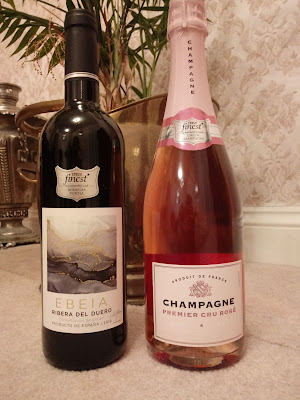
Two Tesco wines for Valentine's Day - pink fizz and Spanish red

Pink fizz is perhaps the most traditional wine for Valentine's Day and spending a few extra pounds on a good Champagne shows you really mean it.

Of course, the reality is that Valentine's falls in the middle of winter when the weather is hardly suited to sitting in the garden and you are more likely to want a steak than a salad for your evening meal

So, here are two wines from Tesco that cover both bases - a good, well-made rosé Champagne to serve as an aperitif or with starters.

Then, a very sophisticated and food-friendly Spanish red to match with a wide range of wintry comfort foods.

Both wines drink nicely on first pouring, but open up with a bit of air, so don't be afraid to open them ahead of time.

The Established Classic - Champagne

If you are buying fizz, whilst there are plenty of good ones around from all over the world, you do need a reason for it not to be Champagne.

And if you are making a gesture, very few people will object to it being that famous northern French fizz.

The Modern Classic - Ribera Del Duero

Ribera Del Duero could be the best Spanish region you've never heard of; whilst Rioja is perhaps the country's most famous red-wine area, Ribera Del Duero is higher and cooler with a harsher, more intense continental climate that results in a structured, concentrated freshness.

The grape is the same as Rioja's - Tempranillo - and geologically the region follows the Duero river that becomes Portugal's Douro, the home of port.

Tesco Finest Premier Cru Brut Champagne Rosé (£23)

a blend of Chardonnay for fruit and elegance with Pinot Noir for colour and weightiness.

red fruits, florality and toasty, yeasty brioche; fresh, ripe, soft red berry fruits, savoury brazil nut and almond and fresh, citrussy sherbet with a fine mousse.

Good.

Serve as an aperitif or match with seafood starters, lighter prawn curries or salmon dishes.

Tesco Finest Ribera Del Duero, 2019 (£12)

darkly fruited, oaky spice, pencil shavings and florality; inky, intense and concentrated yet very fresh and structured; ripe dark berry fruits, liquorice and sweet vanilla spice; fleshy yet with a muscular core. Well-made, sophisticated and enjoyable.

Very Good.

Match with char-grilled red meats, roast lamb or grilled portobello mushrooms

***** 

 Further reviews: Joanna Simon on the Ribera del Duero: www.joannasimon.com

Sunday, 7 November 2021

Posh Fizz and Gamey Red for Autumn-Winter

A traditional-method fizz and sophisticated red for autumn

I've said it before, Crisp White and Big Red is a benchmark combination for wines with dinner.

You can go as smart or basic as you like.

These two wines most definitely fit into the smart category and are perfectly suited to autumnal dining and into winter.


Banfi in Montalcino dates back to 1978 when it was founded by the Italian-American Mariani family who saw great potential in the sleepy Tuscan region. The estate is now the largest contiguous vineyard in Italy and includes land in Tuscany and Piedmont. The estate is planted one third to vines, one third to olive groves, fruit trees and other crops and the remaining third is woodland. Banfi - Wines

On arrival / aperitif

Gosset Grand Blanc de Blancs Brut (£55-65 from Petersham Cellars, Plus de Bulles, The Imperial Wine Company, Bon Coeur Fine Wines, Noble Green Wines, The Champagne Company, Weavers of Nottingham, Davy’s Wine Merchants, Champagne One, The Huntsworth Wine Co, Sandhams Wine Merchants, The Whisky Exchange, Wadebridge Wines, The Vineking, Flagship Wines, Harvey Nichols)

Made from 100 percent Chardonnay grapes grown in fifteen villages of the Côte des Blancs (for finesse) and Côte des Noirs (for structure). Each village and terroir brings its own character, complexities and aromas to the wine, resulting in this exceptional cuvée; the minerality comes from chalk soil that was once an ancient seabed containing millions of small-fossilised creatures.

The grapes are hand-picked; the wines are vinified and aged on the lees for a minimum of three years in bottles stored in their deep chalk cellars.

The clear glass bottles, which are still used today for the Blanc de Blancs, were pioneered by Suzanne Gosset (1885-1970) who ran the house following her husband’s death in the 1950s. The glass underlines the purity and brilliance of the wine’s colour but also evokes the mineral quality found on the palate and the wine’s origins in the region’s chalk soil. The box in which the bottle comes as standard, is to avoid lightstrike affecting the flavour of the delicate champagne.

mineral and floral, with white flowers, white pepper, stone fruits and almond; fresh, citrussy and leesy-complex with bruised orchard fruits, white peach and delicate biscuity brioche; savoury and broad, mineral-saline and elegant.

Very Good; improves with some aeration and will age.

Serve as an aperitif or match with smoked salmon canapes, seafood and fish, such as prawns, scallops, dressed crab, oyster. Alternatively, a simple risotto with parmesan shavings, white meat or a young, fruity Comté cheese

With (gamey) mains

Banfi Rosso di Montalcino 2019 (Sangiovese) (Majestic, £19.99 / £16.99 mix six)

A delicious autumnal Tuscan red from the southern slopes of Montalcino, best known for Italy’s finest world-famous Brunello wines.

Rosso di Montalcino is made from the same 100% Sangiovese grapes, but is an earlier release of the wine, thus retaining the varietal characters and flavours of the Sangiovese grape, but usually with softer tannins.

This is a style that is approachable at a younger age, but still has all the hallmarks of a remarkable Sangiovese wine. This exemplary Rosso is perfect when pheasant and game birds are on the menu (from 1st October) and served with a simple roast or a rich casserole dish. It’s also good with medium aged cheeses. 

Vinified in stainless-steel tanks, resulting in a wine that is less astringent and softer in character. It is then aged for 10-12 months in French oak barriques and casks, followed by a further six months in bottle.

Banfi’s winemaker comments that ‘this is a complex wine characterised by great varietal expression. 

blackberry and raspberry fruit with violets, leathery sous bois, aromatic green herbs and sweet vanilla spice; fresh cherries and red fruits with mocha-coffee grounds, tobacco and spice; very fresh, precise, complex and harmonious. 

Improves with aeration, several hours in the decanter is ideal, and demands food.

Good.

Match with darker game such as venison, pheasant or duck.

Monday, 11 October 2021

Four Christmas Wines from Tesco

Four wines for Christmas Day from Tesco

I've long believed that Christmas Day is not a time to be experimenting with new or off-beat wines; you want something reliable and familiar and, if budgets allow, a little superior to what you might normally drink.

Moving up too many price brackets can actually be counter-productive; for where you can simply crack open and enjoy younger, fruiter wines as soon as they are poured, more ambitious bottles may need a little longer in bottle or more aeration to show their best.

Get it even slightly wrong and your showpiece wine can seem underwhelming, your guests less-than-wowed; under-aged reds reds can seem lacking in fruit and a little chewy until they have opened up; whites that need a bit of aeration can seem basic and underwhelming.

These four Tesco wines are all a step up from everyday drinking but, importantly, also show very well on first pouring. They continue to improve with some aeration but certainly don't require an extensive aging and decanting regime to become approachable.

So that's one less thing to worry about this year, then.

There's a lot to like with these four bottles - big-name wines that don't cost silly money and are easy to enjoy.

The extra-nice surprises are how inexpensive the Champagne is, the superb wine-making of the Bordeaux and the amazing value of the dessert wine.

On arrival

Tesco Finest Premier Cru Champagne Brut NV, (£21.00, vegan) 


IWSC 2021 Gold medal winner and IWC Great Value Champion Sparkling.

This multi award-winning Premier Cru Champagne is produced for Tesco by Union Champagne in Avize, from hand-harvested grapes grown in Premier Cru vineyards in the Côte des Blancs, south of Epernay. Aged for 36 months, this extra maturation results in elegant flavours of citrus, green fruits and brioche with a fine mousse.

Perfect as an aperitif or with smoked salmon crostini.

yeasty almondy brioche and bruised apple with delicate florality; citrussy, linear and and mineral with cidery, bruised orchard fruits and a complex, creamy brazil-nut savouriness; fine mousse. Poised, structured and textured.

Very Good and Good Value.


With starters

Tesco Finest Gavi (£8.50, vegetarian) 


IWC 2021 Silver medal winner This dry, elegant wine is made from premium Cortese grapes from the Gavi region in north west Italy. Part of the crop is harvested later, when grapes are riper, lending extra richness and depth to the wine. 

Its juicy white peach and citrus flavours and long smooth finish make it wonderful with food. Serve chilled with oven-baked fish or pasta dishes.

orchard fruits and white peach with delicate florality and a whiff of white pepper; citrussy, sappy and rich with stone fruits, melon some sweet spice and minerality; good underpinnings.

Good.

The Main Event

Tesco Finest Margaux (£22.00)


IWC 2021 Gold medal winner Made for Tesco by the prestigious Château Boyd Cantenac in Bordeaux's iconic Margaux region, using exceptional quality grapes from vines that are an average of 30 years old. It is a bold but well-balanced red that is rich, ripe and vibrant with complex flavours of dark fruits, cherries, spices and oak.

Serve alongside beef or vegetarian wellington.

dark cherries, bramble fruit, morello cherries, plums, spice and some dried green herbs; full, supple and fresh, with plush ripe dark fruits - cherries, plums, cassis, cool mint and a touch of oaky astringency; complex and very long with very fine, perfectly rounded tannins and a savoury, spicy graphite finish.

Very Good.

With Dessert

Tesco Finest Dessert Semillon 11.5% abv, £6.00 (vegetarian) 


IWC 2021 Silver medal winner and IWC 2021 Great Value Sweet Under £12 

This is an award-winning dessert wine from Australia’s De Bortoli family winery.

Made from late-harvested grapes which are left to ripen on the vine until their natural sugars and flavours have grown incredibly rich and intense. The result is a golden hued wine boasting a delicate concentration of citrus, peach and apricot flavours that are simultaneously sumptuous and fresh.

The perfect dessert wine to pair with Christmas pudding or blue cheese.

floral with overripe stone fruits, sweet spice and musky beeswax; sweet and rich with complex buttery roasted peaches and vanilla sugar; fresh, savoury and long.

Good and Good Value.
***

As an alternative to the Semillon, Tesco's Finest Speyside Single Malt Whisky would also be an excellent match with Christmas pudding - or just sip in your favourite armchair with the Bond film or the Queen's Speech.


Sunday, 20 June 2021

The CWB Fizz-Off: England vs France

Two celebratory wines with bubbles: Hambledon vs De Saint Gall

English fizz is truly world class; we have the cool-climate and chalk soils to make a sparkling wine that can stand up against anything the rest of the world can offer.

Yet Champagne remains the benchmark for sparkling wine, even if only for historic and marketing reasons.

You will pay about the same for an English wine vs an equivalent Champagne; English wines are inherently more expensive to make (smaller scale, cooler climate), whereas the French wines carry more of a price premium.

Here I put two sparkling wines to the test - appropriately, at the start of English Wine Week.

The English fizz is from Virgin Wines, the Champagne is imported by Daniel Lambert Wines.

The Young Turk

Hambledon Vineyards Classic Cuvee Brut NV (£30, Virgin Wines) 

From one of the oldest commercial vineyards in the UK, established in 1952 in Hampshire; the wines have been served on the QE2, in British Embassies, the Houses of Parliament and around the world.

Yeasty brioche with complex, musky toastiness; apple-and-pear fruits with creamy brazil nut and oatmeal, florality and biscuity richness; fresh, precise and linear. Rich, expressive and adept.

Very Good.

Serve as an aperitif or match with seafood, such as prawn vol-au-vent starters or a salmon main.

The Old Master

De St Gall Blanc de Blanc Premier Cru N/V

Blessed with an exceptional terroir, De St Gall takes a collective approach to winemaking with expertise passed down from generation to generation. Thanks to the unrelenting passion of its winegrowers and winemakers, the winery has honed its methods to produce highly singular Grand Cru and Premier Cru Champagne wines of a pure, elegant style, united by a common passion for winemaking, a sense of duty and a desire to share this precious knowledge: they are the guardians of an invaluable legacy that must be carefully preserved as it is brought to fruition.

Pale yellow, expressive with florality, fresh hazelnut, apple flesh, yellow stone fruit, citrus, biscuity brioche and creamy leesiness; full and generous with fine bubbles and freshness; persistent, full and precise.

Very Good.

Serve as an aperitif or match with sophisticated hors d'oevres.

The judgement of Paris?

So, which of these two wines is the better?

That's almost impossible to answer as, within their style, they are both quite different.

Both being traditional method sparklers, they are citrussy and fresh with bubbles in. So far, so similar. They also sit broadly in the same price bracket (if you are fussing over a few £s, you are missing the point at this level).

The English fizz is a blend of 60% Chardonnay, 20% Pinot Noir and 20% Pinot Meunier, giving more richness, weight and expressiveness to the wine, despite it being from much further north.

The Champagne is a Blanc de Blancs, meaning 100% Chardonnay; this means more florality and elegance. Everything is just that little bit finer and, I suspect, it will improve with age in a more interesting way than the English fizz.

So, an honourable draw, then.

*****

Other reviews

Jamie Goode calls the Hambledon "quite brilliant. 93/100 " - full review here: 

Sunday, 16 May 2021

Poshed-Up Crisp White and Big Red

Two wines for a sophisticated lunch, supper or dinner party - Pink Fizz and Classy Red

Crisp White and Big Red is something of a modern staple for Wines to Have with A Meal; something fresh to start with, followed by a full-bodied red to match with a hearty main course.

Plenty of wines will meet this brief and a more-special occasion often demands no more than trading up to a Chablis Cru or a Sancerre for the white followed by a slightly older Rioja / Bordeaux / Rhône for the main.

If, however, you want to go in a different direction, consider a pink fizz and a classy Spanish red - Henriot Rosé NV and Familia Torres Purgatori.

If you want to quietly impress someone - your boss, new neighbours, the in-laws - with your sophistication, knowledge and generosity, you could do much worse than to serve these two wines over a simple but exquisite supper of smoked salmon followed by venison casserole. 

Both these wines have back-stories worth telling once you've moved on to brandy and cigars, but what matters most is what's in the glass.

Starters

Henriot Rosé NV, Champagne (around £55 from Liquorice, North & South Wines (by the case), Loki Wines, Amazon) 

One of Champagne's oldest family-run houses, Pinot Noir from the Montagne de Reims is vinified as a red wine and is added to Chardonnay from the Cote des Blancs with some Pinot Meunier.

Aromatic yeasty brioche, red berries with florality, white pepper and cloves; redcurrant, red cherry and wild strawberry with freshly squeezed lemon, pink grapefruit, mandarin  and candied fruit; linear and textured with a persistent minerality. Intense yet elegant and balanced; linear yet rounded, precise yet generous, very sophisticated.

Very Good.

Match with marinated salmon, crab and pea shoots, chicken Caesar salad or smoked salmon, crème fraiche and caviar.

Mains

Familia Torres Purgatori, 2017, Costers del Segre, Spain (around £20, independents)

A blend of Garnacha, Carinena and Syrah, aged in French oak (40% new) for up to 18 months.

Red and black cherries with spice, damp soil, oaky spice and violets; plum, dark-berry fruits and sour cherries, scrubby garrigue herbs and grilled flavours with pencil shavings; assertive, very fine and well-integrated tannins; full and supple yet fresh. Concentrated, intense and complex.

Drinks nicely on first opening; can also be cellared.

Very Good.

Match with roasted, grilled or barbecued red meats or a plate of cheese and cold cuts, especially Ibérico ham.


Notes from the producers:

Henriot

Champagne Henriot, established in 1808, has remained in the same family-ownership for over 200 years and is now run by 8th generation family, Gilles de Larouzière Henriot.

The Champagne comes from one of the oldest family-owned houses in Champagne, enjoying seven generations of uninterrupted ownership since the late 1700s. Champagne Henriot's Rosé Brut is obtained by adding Pinot Noir vinified as a red wine to the assemblage.

Rosé Brut is made up of a majority of Pinot Noir from the Montagne de Reims and Chardonnay from the Côte des Blancs. More than 15 crus are blended, including the following vilage crus: Avize, Chouilly, Mareuil sur Aÿ, Verzy, Verzenay, Avenay, Vertus, Trépail and Epernay. A small percentage of Pinot Meunier adds a delicate fruit note to the wine. 

As with all their Champagnes, Henriot select grapes from the very best vineyards in Champagne’s Grands Crus and Premier Crus. Each parcel of grapes is fermented separately to capture the individual characteristics of its terroir and village, allowing Henriot’s cellar master, Alice Tétienne, to reproduce the Henriot’s ‘house style’ blend each year.

Henriot Rosé is a blend that showcases the very best Pinot Noir grapes (50%) from the Montagne de Reims, whilst retaining the freshness of Chardonnay (40%) and a small percentage of Pinot Meunier (10%) adding a delicate fruity note.

Henriot Rosé also contains a proportion of precious reserve wines which make up 35% of the blend. Every bottle is left to rest in the cool, calm surrounds of Henriot’s cellars in the centre of Reims, for three years.

Torres

Familia Torres Purgatori was the first ever Torres’ single vineyard wine from the DO Costers del Segre, an area in the Penedès known for its arid lands, extreme climate and harsh conditions. The name of the wine pays homage to the wayward monks of Montserrat Abbey, who as far back as 1770, were sent here, to the Desterrats estate, to carry out their penance and provide food for the Diocese. They soon discovered this inhospitable place was perfect for growing grapes and making wine. Legend has it that enormous barrels of the wine they produced mysteriously disappeared, with some saying that ‘the angels have taken them away to heaven’.

The actual explanation is probably more earth-bound. As it was good enough for the monks to make wine, it posed an attractive proposition for Familia Torres, who acquired the historic 870-hectare L’Aranyó estate in 1999. Torres began the recovery of its wine-producing past, planting the vineyard with Cariñena, Garnacha and Syrah and preserving the centuries-old olive trees.

Thanks to the harshness of these conditions, these typically Mediterranean varieties adapted well to the terroir, contributing to the uniqueness and elegance of Purgatori. Familia Torres 

Stored under the right conditions, Purgatori will keep for 10 years. Patience really does have its rewards. Today there are 200 hectares of organic vineyards, distributed from 330m to 550m altitude at its highest point, of which 50 hectares are used to make Purgatori. 

The intense summer heat, lack of water and limestone soils favour slow ripening of the grapes giving rise to wines of great aromatic intensity. The vines produce some of the lowest yields in Catalonia and are hand harvested at perfect ripeness, often in lots two weeks apart. The grapes are manually processed into separate batches to preserve the integrity of the fruit, each of which adds a different profile and character to the wine.

This is one of Miguel Torres Maczassek’s personal favourite projects as the estate is also an excellent testing ground for ancestral grape varieties that the family has recovered in the last thirty years, not only for winemaking potential, but also to see if they are also resistant to climate change. Among them Querol and Gonfaus have adapted to the extreme climate of the area. A new winery was built in 2018 linking the old farmhouse built by the Benedictine monks, seamlessly blending the modern and old architecture. Stainless steel and custom-built concrete vats, using rocks from the vineyards themselves, are used for vinification. Familia Torres Purgatori 2017 – bringing the past to the present. Heaven can wait.

Thursday, 7 January 2021

Chassenay d’Arce Vintage Champagnes

Two vintage Champagnes from Chassenay d’Arce - with something very unusual

The grapes

One of the first things I learnt about Champagne is that there are three Champagne grapes, Chardonnay, Pinot Noir and Pinot Meunier.

Much later I learnt that Champagne actually permits a much wider range of varieties, including Pinots Blanc and Gris (which are clones or mutations of Pinot Noir).

The classic trio of Champagne grapes accounts for 99.7% of plantings, so you are unlikely to find anything else in a bottle of Champagne.

Chassenay d’Arce, however,  own a few blocks of Pinot Blanc; for the 2008 vintage, they blended a small amount of Pinot Blanc into their Champagne. In 2012, they made a 100% varietal vintage Pinot Blanc Champagne.

The House

Chassenay d’Arce was founded in in 1956 and is based in Ville-sur-Arce in the very South of the Champagne region. It covers 315 hectares and 12 villages along the Arce River in the Côte des Bar.

The House has grown from its five original founders to some 130 families with three generations of winemakers united by a self-declared spirit "of family, terroir and the high standards shared by our winemakers to ensure we produce only champagnes of the greatest quality."

Terroir and Technique

The Arce Valley is located at the southern end of Champagne and is shaped by a unique landscape alternating between vineyards and forests; it is also characterized by diverse varieties and integrated cultivation.

The soil is Kimmeridgian and was once covered by the sea. The climate is mild, the region is physically closer to Dijon in Burgundy than to Reims and this, the grapevines’ exposure and the soils of stony marl allow the fruit to be harvested at full maturity towards the end of summer.

The original operations endure with the same spirit of cooperation, solidarity and knowledge sharing; the winemakers use only their top grapes from the first pressing and all bottles are aged for a minimum of 36 months.

This attention to detail and commitment to quality creates a range of Champagnes with rich expression  great finesse and many awards.

2012 Pinot Blanc

Made from a few blocks of long-forgotten Pinot Blanc, this is a remarkable wine.

100% Pinot Blanc, vinification in temperature-controlled stainless steel tanks with barrels for 6% of the wine. Non-malolactic fermentation for 19%, aged in bottle for 6 years on the lees. Extra brut dosage: 3 g/l, 12% 

Pale yellow with green and a lively mousse, expressive, fresh aromas with white, yellow and citrus fruit and floral and delicately toasted notes. Rounded and generous, with a full body and texture, saline minerality.

It is initially quite shy aromatically and still tightly wound, but there is a pure, concentrate and muscular core that gradually opens up with aeration. This wine is only just at the beginning of its drinking window and will repay extensive cellaring.

Very Good.

Drink as an aperitif or match with shellfish and raw fish.


Vintage Brut 2008

A refined and delicate blend from a fantastic year.

58% Pinot Noir, 34% Chardonnay, 5% Pinot Meunier & 3% Pinot Blanc; vinification in temperature-controlled stainless steel tanks and in barrels for 2.5% of the wine. with partial malolactic fermentation. 

Aged in bottle for 10 years on the lees; Brut Dosage of 9 g/l, 12 % alcohol.

Bright pale yellow with green and fine, generous mousse; expressive, complex and fresh aromas of citrus, white and yellow fruit and white flowers, with brioche, toast, and some hazelnut. Delicate yet precise and taut with good structure and minerality; persistent, fresh and long finish.

This is a very pure and precise Champagne, still closed up even at over a decade; dense, concentrated and textured, it opens up with aeration and will repay extensive cellaring.

Very Good.

Drink as an aperitif ort match with amuses bouches or fish

Monday, 16 March 2020

Daniel Lambert Portfolio Tasting

By Benjamin Marshall - Dictionary of National Biography. Original is now owned by Leicestershire Museums and Art Galleries., Public Domain, https://commons.wikimedia.org/w/index.php?curid=10847154
If, like me, Adrian Mole and Richard III, you have a connection to Leicester, you can't help knowing that Daniel Lambert was once Britain's fattest man.

He claimed neither to have eaten nor drunk to excess and to have been reasonably active, but with no other medical symptoms, history's verdict is that this was probably a fib and he was just a lazy porker.

Still, he clearly enjoyed the good life and was even something of a celebrity, charging people to experience his enormous bulk "in the flesh", so to speak.

This, however, is not the Daniel Lambert you are looking for. Unrelated to my childhood local hero, award-winning Daniel Lambert Wines was established around 30 years ago just off the M4 in south Wales.

A simple test of a wine merchant is to pick a few wines at random; if they are all good, then you've probably found a reliable one.

There was nothing I didn't like at this tasting; all the wines were at least Good, many much better than that.

De Saint-Gall my new favourite Champagne house - excellent NV and an astonishing Grand Cru 2004

Montgomery well-made red and white wines from Wales

Domaine Philippe Raimbault elegant and concentrated Loires; Pouilly Fume and Sancerre

Cave OEdoria supple and elegant Beaujolais

Burgundy lots of lovely, elegant reds at varying price points from Domaine de la Galopiere, Domaine Lamy Pillot, Domaine Jean Fery, Fournier ets Fils, Domaine Marchand Grillot

Bordeaux amazing mature Pessac-Leognan from Couhins-Lurton (white, 2015) and La Louviere (red, 2010), plus a superb 2015 Sauternes from Filhot.

Calmel & Joseph the Languedoc Malbec that first turned me on to Daniel Lambert

Cotes du Rhone supple, inky, spicy Rhones from Pasquiers, Les Hauts de Mercurol and Fourmone

Rioja youthful, fresh Rioja with some age from Pascual Larrieta

Canada fresh and elegant cool-climate wines from Westcott

Dom Brial possibly the highlight of the tasting, a collection of superb Rivesaltes including a Rancio Sec 2000, sweet Ambre 2010 and a series of wines from the last century that, like Mick Jagger, just seemed to get better with age: 1999, 1979 and - my favourite - 1969.

Tuesday, 1 January 2019

Veuve Clicquot NV from The Co-op

A Christmas fizz from the Co-op

If you want to celebrate, nothing says it quite like fizz and if you want it to be classy, then it has to be Champagne.

The Co-op does and excellent range of fizz and Veuve Clicquot is a name amongst Champagne houses; it was founded in 1772 and is credited with:

- creating the first known vintage champagne in 1810
- inventing the riddling table process to clarify champagne in 1816
- invented the first known blended rosé champagne

During the Napoleonic Wars, Veuve Clicquot established the wine in royal courts throughout Europe, notably that of Imperial Russia, and played an important role in establishing champagne as a favoured drink of high society and nobility throughout Europe.

Veuve Cliquot, NV Champagne (£40) fresh orchard fruits, citrus and leesy complexity; long and linear, elegant and fine.

Good.

Drink as an aperitif, or match with light canapes.

Saturday, 15 December 2018

Classic Co-op Christmas Wines

Three classy and classic wines for Christmas from The Co-op

Christmas is not a time to experiment - trying to persuade distant relatives of the merits of some obscure and strangely-made wine from central Asia does not usually go down well over a post-Christmas dinner game of tiddly winks whilst waiting for the Dr Who Special.

There is a time and a place for experimentation and a house full of family-on-best-behaviour all trying to maintain a veneer of civility to each other is not it.

So, keep it classic and classy with three well-made Old World standards from the Co-op and you can't go wrong.

Aperitif
It has to be fizz and if it has to be classy, then Champagne is your only option.

Veuve Clicquot NV Champagne (£40) elegant and classy NV Champagne

Christmas roast
Bordeaux's Medoc makes elegant and structured food-friendly wines that match perfectly with roast meats.

Château Sénéjac Cru Bourgeois (£17) distinguished Cru Bourgeois producer in the Haut-Medoc; vintage matters in Bordeaux and 2015 was a very good year; this now has just enough age to be ready for drinking

Christmas pudding, mince pies and sipping into the evening
Port is one of the world's great wines; vintage port shows cherries, eucalyptus and spice with strength, elegance and more nuance and complexity that any other style

Taylor's Quinta de Vargellas (£30) the lifetime of vintage port is measured in decades, so this 2004 is still a baby, only just ready for drinking

Saturday, 17 March 2018

Bordeaux and Champagne: From Vineyards Direct

A classy-yet inexpensive Bordeaux and Champagne from FVD

These two wines from FVD are both classics and relative bargains; the Champagne is from a tiny, family-owned producer whose vineyards on the Montagne de Reims are all Premier Cru.

The red is a more-affordable stable-mate of first-growth Haut-Brion.

Champagne Arlaux, Premier Cru Gande Cuvée NV (£32.95) yeasty-citrussy with toasted hazelnuts, orchard fruit toasty brioche. Fine mousse, elegant and balanced with a long nutty finish.

Good and will improve further with age.

Drink as an aperitif or match with light starters.

Clarendelle Red 2012 (£16.95) classy, classic Bordeaux with a bit of age; bramble fruits, pencil shavings and earthy-woodsiness, fine tannins and freshness. Complex, adept and very well-balanced. Drinking nicely now, this is as good a mid-range Bordeaux as you can hope to find.

Good and Good Value for the quality; will only improve with further aging.

Drink with red meat, especially darker game.

Friday, 9 March 2018

Les Pionniers NV Rosé - Co-op

A substantial and complex pink fizz from the Co-op

I have been impressed with the Co-op's Pionniers Champagne - in both standard NV and vintage formats.

Now, the range is extended to include a pink - perfect for Valentine's, Mother's Day or any other occasion when you want to make a statement and ensure that it be a classy one.

Key facts are: 60% Pinot Noir, 40% Chardonnay with up to four years on the lees in the Piper Heidsieck cellars. 

Les Pionniers NV Rosé Champagne (£21.99) a delicate pink in the glass with summer fruits and toasty, yeasty brioche; red berries, raspberries, creamy-oatmealy cashew nuts and a fine mousse; persistent and weighty with a leesy, mineral complexity.

Improves with aeration and will repay a few years' cellaring.

Good.

Drink as an aperitif or match with canapes, salmon or charcuterie.

Friday, 2 February 2018

Taittinger For Valentine's

Two celebratory wines for Valentine's from Taittinger

If you want to make a statement on Valentine's day, fizz is a good start; high-quality pink Champagne will show that you really know what you are doing.

Here are two from Taittinger.

Taittinger Brut Prestige Rosé (£50.60 Waitrose, Asda, Wine Rack, Majestic, John Lewis, independents) delicate nose with some brioche leading to delicate ripe red-berry fruit; fresh and mineral with a fine mousse. Very elegant.

Good.

Drink as an aperitif or match with light seafood.

Taittinger Nocturne Rosé ‘City Lights’ NV (£54.50 Harrods, independents) fresh and substantial, with a fine mousse and the weightiness of a generous dosage; dry and balanced with orchard fruits, citrus and delicate raspberry. Refined and easy-drinking.

Good.

Drink as a sipper throughout the evening, or match with soused salmon or prawns.

Friday, 15 December 2017

Special Christmas Drinks From The Co-op

Two special Christmassy drinks from The Co-op

Christmas is a time for special drinks - not just superior versions of what we might normally drink, but drinks that are inherently associated with Christmas; Champagne's fizz suits the celebratory mood perfectly, whilst a sip of mellow aged spirit allows us time to relax.

The fizz follows a tradition of great, and great value, Champagnes from the Co-op; it recently won a Gold Medal at the Champagne and Sparkling Wine Championships. The whisky has a silver from the IWSC and is also great value for a whisky of this age.

Les Pionniers, Champagne 2006 (£25.99) Golden sandy yellow, it is complex, precise and assured, with orchard fruits and hints of redcurrant, musky melonskin, yeasty-biscuitiness and a fine mousse; taut citrus acidity, some aged, nutty character and a persistent minerality.

Very Good.

Crisp enough for an aperitif, but will match well with seafood starters and roast guineafowl.

Co-op Irresistible 12 Year old Scottish Highland Whisky £23.49 (70cl) golden, mahogany toffee colour, with a complex nose of citrus, sandalwood and roasted spices; cooked mixed fruit, pastry shop, sweet vanilla and complex dark sherry flavours.

Warming, assertive and persistent.

Good value and Very Good.

Match with haggis, dark chocolate and espresso and a crackling log fire.

If you are looking for table wines to match your Christmas dinner itself, the Co-op recommends these:

Fish starter silver winner, New Zealand Irresistible Explorer’s Sauvignon Blanc (£7.49)
Festive main silver winner, Australian Henry's Drive Shiraz (£16.99)
Cheeseboard silver winner, Finca Las Moras Barrel Select Malbec (£7.99)

Monday, 9 October 2017

Top Selection Portfolio Tasting

The Autumn portfolio tasting from Top Selection

Top Selection is an award-winning boutique wine and spirits merchant that has been running since 2000.

This autumn portfolio tasting featured over 80 wines - in general, they were all well-made and fault free, reasonably typical and fair value for money.

Some were more interesting than others, so here are the ones I liked best:
Fizz
Andre Jacquart Le Mesnil Grand Cru NV, Champagne complex, leesy and adept. Good.

Whites
Angel Sequeiros Albarino "Foudre" 2010, Rias Baxas complex, oaky, mineral and very long. Incredibly youthful, will age and age. Good.

Laurent Boussey Meursault "Clos du Pre" 2015 citrussy, deft and complex with layers of sophisticated oak; still young. Good.

Reds
David Duband Chambolle Musigny 2013 mushrooms, truffles, red berry fruit and spice; complex, long and supple. Good.

Alves de Sousa Caldas Reserve Touriga Nacional 2012, Douro minty eucalyptus, ripe dark fruit, gaminess and pappery spice; supple and fresh with fine tannins. Good.

Kracher Blend 2 2013, Burgenland vibrant with fresh, ripe, juicy blueberries, coffee grounds and spice. Good.

Ceretto Barolo 2013 fresh and elegant with a firm grip; cherry fruit and long. Good.

Dessert wines
Kracher Beerenauslese 2015, Burgenland roasted peaches in caramel with good freshness. Good.

Clos le Comte Cuvee Emilie 2015, Sauternes sweet spices, buttery roasted stone fruits and caramel. Good.

Szepsy Aszu 2000, Tokaji cognac coloured and complex, with roasted peaches and sweet spice. Long and mellow with aged complexity. Very Good.

Alves de Sousa Quinta da Gaivosa LBV, 2012 fruited, fresh and delicious, typical LBV. Good.

Spirits
La Gabare is one of the last independent cognac houses - founded in 1992 they select, age and sell rare old cognacs.

La Gabare Petite Champagne 1970 complex, vibrant and fiery (60% strength!), spicy and expressive. Very Good Indeed.

La Gabare Petite Champagne 1982 complex, with mixed fruit and sweet spice. Mellow and harmonious. Very Good.

Thursday, 5 October 2017

Christmas in September - With Louis Latour And Friends

A Christmas-themed tasting of top wines from Louis Latour and others at The Bleeding Heart

Some people love Christmas - my children, for example; at its best, it is a time that brings people and families together, a time of shared experience and togetherness.
Food and drink play a part, and if quality is important to you, then you want to put something superior on your table.

Louis Latour helpfully laid on a four-course Christmas lunch at The Bleeding Heart and provided a selction of wines with each course.

Food, wine and company - very Christmassy, and what's not to like?

All the wines were good in their own way; choices really come down to personal preference and budget.
On arrival

Gosset Grande Reserve Brut NV (£45 - £49) deft, elegant and substantial Champage. An excellent start. Very Good.
Starter - marinated salmon and crab
Simonnet-Febvre Chablis Premier Cru Vaillons 2015 (£26.99) deft and complex, with orchard fruit, honeysuckle and minerality. Long and still very young. Very elegant. Very Good.

Seresin Estate Sauvignon 2015 (£14.99) a biodynamic blend of the New World and the Old with a dash of Semillon in the blend and barrel aging; Marlborough character with European texture, restraint and fruit ripeness. Long with good underpinnings. Good.

McHenry Hohnen Amigos White 2012 (£15.99) a blend of Chardonnay, Marsanne and Roussane from Western Australia; toasty oak, fresh and citrussy with a broad waxiness. Incredibly vibrant and youthful. Good.
Main - Norfolk turkey with trimmings

Louis Latour Aloxe-Corton Les Chaillots 2011 (£39.99) elegant and long with good underpinnings; cherry fruited Burgundy in a traditional style with very fine tannins. Wine-making of a very high standard. Good.

Viu Manent ViBo Vinedo Centenario 2013 (£16.99) minty, blackcurranty Chilean Cab with a dash of Malbec; a mix of power and subtlety plus old-vine concentration.

Vidal-Fleury Cairanne 2012 (£13.50) meaty, spicy, substantial Rhone red with red fruits and florality. Long, with good underpinnings. Very Good Value. Good.
Cheeses
Louis Latour Pouilly-Vinzelles 2015 (£19.99) fresh and honeyed with orchard fruits and citrus. Sophisticated and versatile. Still young. Good.

Henry Fessy Brouilly 2015 (£12.99) ripe, elegant, pure and fresh with raspberry fruit and pencil shavings. Very Good Value. Very Good.


Wakefield  Estate Cabernet Sauvignon 2015 (£12.99) rich and textured yet fresh Cab from Clare Valley with minty blackcurrant.
Dessert - Christmas pudding with brandy creme anglaise
Barbadillo La Cilla PX (£24.00) aged for 25 years, complex dried fruits and figs, roasted nuts and Christmas spices; mellow, with the savouriness of age. Rich and sticky. Good.

Blandy's 15yo Bual (£25.00) rich fruitcake and freshness with spice and mellowness. Lovely. Good.

Pellegrino Passito DOC Pantellaria 2016 (£11.50) dried Moscato d'Alexandria grapes; spicy sandalwood, tangerine zest, floral and fresh. Very distinctive. Good.
Digestif
Fontpinot XO (£105) rich mixed fruit, sweet vanilla spice, warmth and roasted spices. Long and complex - balances softness and delicacy with a powerful concentration. Very Good.

Sunday, 4 December 2016

Marques Et Co-op - Part Deux

A follow up to the Marques et Co-op tasting in London

With a free diary, some surplus holidays and the offer of lunch in Paris, I found myself stepping down from the Eurostar and wandering to Carré des Feuillants, just off Place Vendome.
I had tasted these Marques et Co-op the wines previously, so this was a chance to take a more nuanced view.

Once again I came away with the view that the standard is high across the board, with good attention to detail; all the wines scored well for freshness, balance and precision.
A good number also showed a superior level of concentration and muscularity.

If absolutely pushed to pick a set of wines drinking nicely now for dinner, I would take the following:

- Confidences Rosé Brut 2009
- Rasteau Ico(o)n 2010
- Astrolabe Vendages Tardives 2012 Gaillac
I sorted the wines into two categories - the good and the more ambitious.

The Good

Les Combes 2013 Beaujolais-Villages fresh, balanced and elegant; textured and concentrated

Memoria Vieilles Vignes 2013 Beaujolais more old-vine core substance

Cellier des Princes 2015 Chateauneuf du Pape dark fruited, spicy, fresh and supple

Estandon Legende 2012 Cotes de Provence floral and scented, clean and pure, elegant and poised with fresh red-berry fruit

Solstice d'Estandon 2015 Cotes de Provence delicate and elegant yet athletic

Jubilation Le Pallet 2014 Muscadet Sevre & Maine creamy-leesy and fresh with a substantial texture; Burgundian

Le Fauteuil Rose 2014 Chinon fresh raspberry and pomegranate fruit with spicy, grilled notes

Ortas Rasteau Prestige 2011 dark fruit, florality, spice and liquorice with cool mint, blackcurrant pastilles; supple

Toques et Clochers edition limitee Cremant de Limoux Brut fresh, floral and expressive; substantial with toasty brioche and a southern warmth

Toques st Clochers Terroir Haute-Vallee 2014 Limoux fresh, aromatic and floral; creamy, oatmealy with sweet spices

Tutiac, Lieu-Dit Ter Pointe 2014 Cotes de Bourg varietal Malbec with dark fruits and spice; concentrated, substantial and oaky, still closed up

Prestige du President 2015 Corse rosé fresh redcurrant fruit, clean and precise

Prestige du President 2013 Corse Rouge dark fruited, expressive and inky with a Mediterranean, windswept freshness
The More Ambitious

Celliers des Princes, Les Hauts des Coteaux, Chateauneuf du Pape 2012 bigger, fuller and more complex; lots of everything. Needs 5+ years to reach maturity.

Chassenay D'Arce Confidences Brut Rosé, 2009 muscular and concentrated with delicate red fruits and a substantial, athletic core; poised, balanced and linear.

Confidences Brut BdN fresh, poised and linear; substantial, very long and fresh with leesiness, apple-and-pear fruit and a fine mousse

Ortas Rasteau Ico(o)n 2010 complex, inky texture; substantial, long and muscular with red, black and sour cherry fruit. Drinking nicely now and will age.

Tutiac, Lieu-Dit Verdot 2012 Bordeaux liquorice, spice and dark fruit with freshness and a a substantial, muscular core. Still young.

Ch Tour de Yon, St Emilion GC 2012 fresh, dark and inky with a substantial, muscular core; still closed up but spicy and full

Aurelius, St Emilion Grand Cru 2012 dark fruited with cool mint and spice; long, substantial and concentrated. Still closed up.

Astrolabe Cahors 2014 Malbec supple, harmonious and balanced with lovely, rounded tannins; dark fruit and cool mint

Astrolabe Gaillac Vendanges Tardives 2012 ripe peaches, beeswax and sweet spices cut through with freshness

Other related articles
 London tasting of Marques et Coop
An Epic Lunch - in Pictures 

Main photo by Sarah Canonge - full set of pictures here.

Sunday, 13 November 2016

Three Production-Method Wines from Tesco

Three wines defined by their production method - from Tesco

Asked about my favourite type of wine, the closest I get to a definitive answer is "wines defined by their production method".

It is a somewhat counter-cultural response - there is nothing artisan about a replicable industrial production method - and yet these wines, including sherry, port and Champagne, have an underappreciated classic quality.

When done well, of course.

Most production-method wines are, I suspect, happy accidents, turning underwhelming base materials into something more complex through the addition of a further process.

Serve the Champagne as an aperitif, with light starters or even roast chicken; the sherry will match with roasted almonds and olives or roast beef; drink the port with cherry and chocolate torte.

Champagne Taittinger Brut NV orchard fruit, leesy richness, biscuitiness and fresh citrus acidity with a mineral backbone. Complex, elegant and adept with a fine mousse. Good.

Harvey's Medium Dry Amontillado golden with wood spice and roasted hazelnuts; off-dry with roasted spices.

Graham's 10 Year Tawny Port roasted nuts, raisins and figs with herby-eucalyptus and red fruits. Good.

Other related articles
Production-Method Wines

Tuesday, 8 November 2016

Two Cool-Climate Whites

Two cool-climate white wines from northern France

Earlier this year, I did two things - I swapped a load of old boxes for a bottle of Champagne from photographer Jean-Luc Benazet and I bought the remnants of sommelier Oscar Malek's wine collection.

I can't help feeling I got the better side of the bargain in both cases.

What these two wines have in common is that they are made at the margins of where wine production is possible and yet, they have a richness that comes partly through production method and partly through age.

The Loire was born in the year I went to university; the Champagne is NV but has signs of extended cellaring.

Champagne Meteyer NV Cuvee Marine fresh apples-and-pears orchard fruit, yeasty brioche and autolytic flavours; some aged character with a hint of briny oyster shells. Very fine mousse.

Fresh, elegant and deft.

Very Good.

Drink as an aperitif or match with light starters.

Vouvray Moelleux Reserve 1989, Daniel Jarry complex and aged with baked apples, fresh peaches, sweet spices and beeswax, waxy lanolin and old leatherbound books. Long, mellow yet energetic, rich and substantial with a fresh, mineral streak. Feels barely more than off-dry.

Glorious.

Very Good Indeed.

Matches with savoury and sweet foods as well as cheese, but shows its best as an after-dinner sipper.

Other related articles
Somm Guys Have All The Luck
Two Special-Day Wines
On Jean-Luc Benazet

Sunday, 5 June 2016

Three Rosés

Three very different rosés

It does not have to be hot and sunny to drink rosé - but it helps.

These three pinks are all very different in style and budget, but all have relatively similar flavour profiles and will match with prawn or salmon starters.

Or, on a hot enough day, serve as an aperitif in the garden with friends.

Inexpensive, Expressive New World
Cleefs Classic Collection Rosé 2014 (£8.95, independents) aromatic, ripe and plump with soft red fruits and a touch of toasty, mineral pungency; a sophisticated, crowd-pleasing easy-drinker.

Sophisticated and unsual Sancerre pink
Joseph Mellot Sancerre Le Rabault Rosé 2014 (£18.80, independents) ripe soft red fruits, a hint of smokiness and mineral salinity.Very deft and elegant.

Classy and aristocratic pink fizz
Taittinger Nocturne Rosé ‘City Lights’ NV (£60.40, Harrods, Ann et Vin) redcurrant fruit, refreshing citrus and leesy minerality. Fine mousse. Weighty and substantial yet deft and adept.

Other related articles
Provence rosé
Not Just Pink Wine - Chateau de Berne